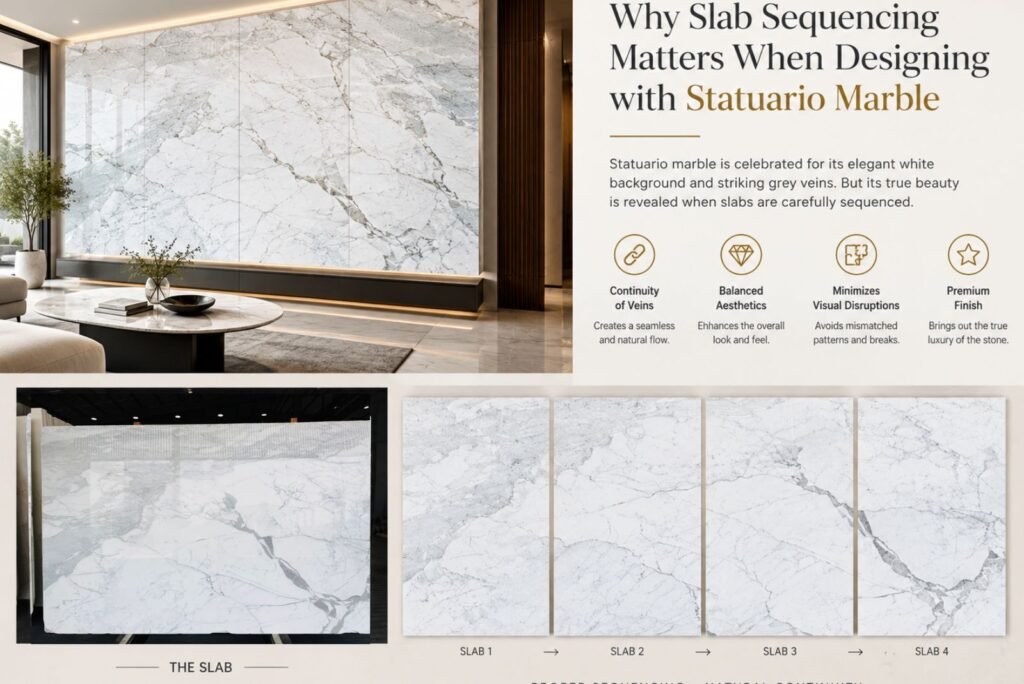
When designing a luxury interior with Statuario Marble, choosing the right slabs is only part of the process. An equally important decision is determining how those slabs will be positioned, matched, and installed. This process is known as slab sequencing.
Statuario Marble is admired for its bright white background and distinctive grey veining. Because every natural marble slab has its own pattern, two slabs from the same block may look different when placed beside each other. If the sequence is planned carefully, the veins can flow beautifully across walls, floors, countertops, staircases, or large feature surfaces. Without proper planning, even an expensive marble installation can lose visual continuity.
For homeowners, architects, and interior designers considering Statuario Marble in Kishangarh, understanding slab sequencing can make a significant difference in the final appearance of a project.
What Is Slab Sequencing in Marble Design?
Slab sequencing is the process of deciding the order and orientation in which individual marble slabs should be installed.
Before fabrication begins, the slabs are inspected for:
- Vein direction
- Vein density
- Background consistency
- Natural markings
- Shade variation
- Bookmatching possibilities
- Required dimensions
- Position within the overall design
Instead of treating every slab as an independent piece, designers consider the complete surface as one visual composition.
This is especially important with premium natural stones such as Statuario Marble, where the veining itself becomes a major part of the interior design.
Why Slab Sequencing Is Important for Statuario Marble
1. It Creates Better Vein Continuity
One of the biggest advantages of proper slab sequencing is improved vein continuity.
Imagine a large living-room feature wall made from several Statuario slabs. If each slab is installed without considering the neighboring piece, the veins may suddenly change direction or appear disconnected.
With careful sequencing, the slabs can be arranged so that the natural movement of the veins feels intentional.
This can create a more sophisticated appearance across:
- Feature walls
- TV walls
- Lobby walls
- Reception areas
- Large bathroom walls
- Kitchen backsplashes
- Staircase walls
- Luxury flooring
2. It Helps Achieve Bookmatched Designs
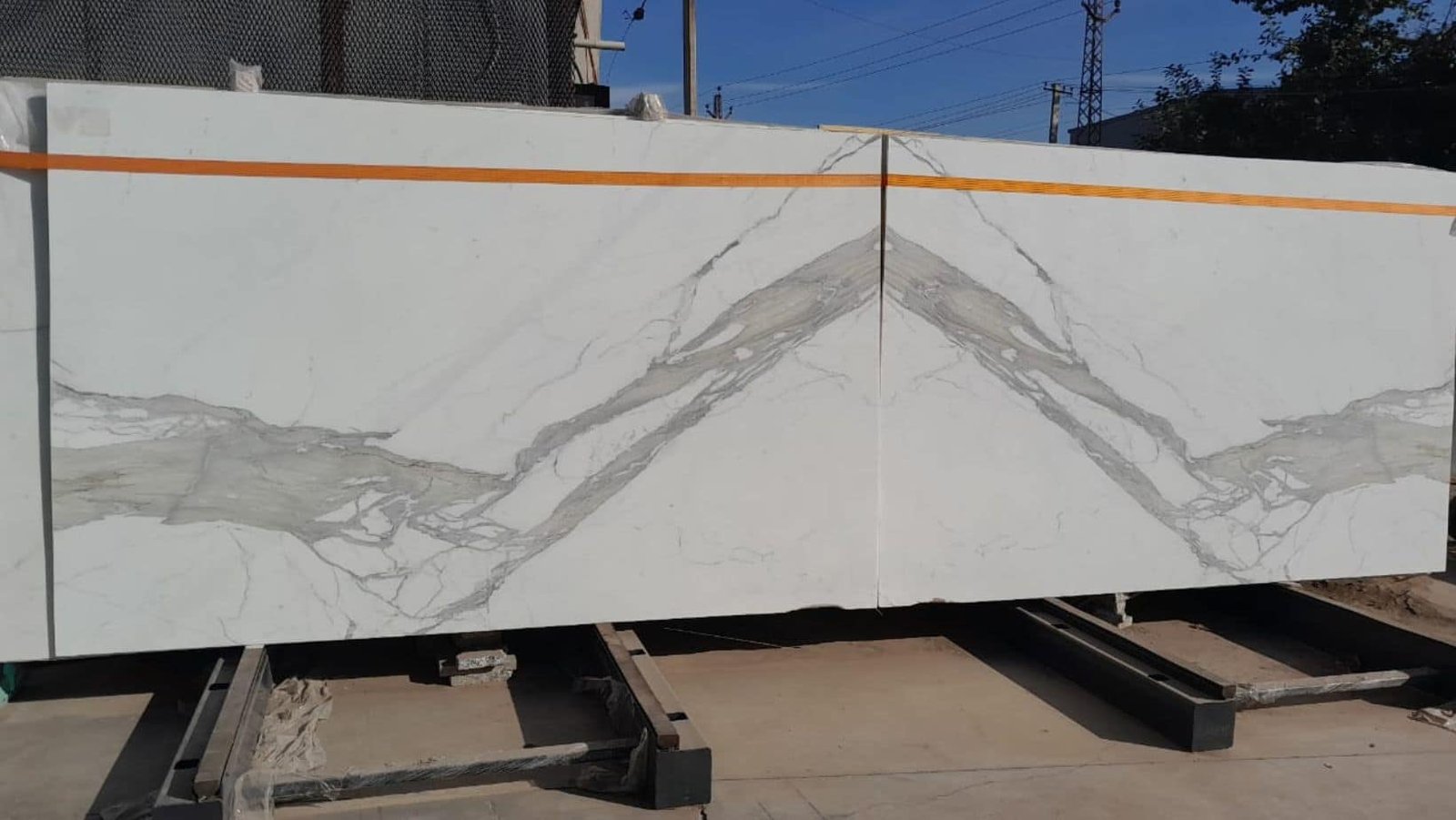
Bookmatching is one of the most visually striking ways to use veined marble.
Two adjacent slabs are positioned like the pages of an open book, allowing their vein patterns to mirror or complement each other.
Statuario Marble can be particularly impressive in bookmatched applications because its contrasting grey veins stand out against the lighter background.
However, bookmatching is not simply a matter of placing two slabs side by side. The slabs need to be selected and sequenced according to their vein structure, thickness, dimensions, and intended installation area.
3. It Reduces Unwanted Visual Disruptions
Natural marble is not manufactured like a printed tile. Variations are part of its character.
A slab may contain:
- Strong veins
- Fine veins
- Cloud-like patterns
- Subtle grey movement
- Natural mineral marks
- Differences in white background
If a very heavily veined slab is placed next to an extremely plain slab without considering the overall design, the transition may look unbalanced.
Proper sequencing allows these natural variations to be distributed more thoughtfully.
Slab Sequencing Should Start Before Cutting
A common mistake is to think about marble arrangement only after fabrication has started.
For high-end Statuario projects, sequencing should ideally be considered during slab selection itself.
The design team should first understand:
- Where the marble will be installed
- How many slabs are required
- Which surfaces will visually connect
- Whether bookmatching is desired
- Where joints will occur
- Which areas need the strongest visual impact
- How the marble veins should travel across the surface
This approach can prevent unnecessary cutting and help maximize the visual value of premium slabs.

Statuario Marble for Feature Walls
Feature walls are one of the applications where slab sequencing becomes especially noticeable.
A large marble wall can become the focal point of a living room, entrance lobby, bedroom, hotel reception, or commercial space. If several slabs are required, their sequence should be planned before installation.
For example, a designer may want the strongest vein to move diagonally across the wall rather than suddenly stop at a joint.
The objective is not necessarily to make every slab identical. Instead, the goal is to create a balanced visual rhythm while respecting the natural characteristics of the stone.
Sequencing for Marble Flooring
Flooring requires a different approach.
When Statuario Marble is used across a large floor, designers need to consider how the slabs or cut pieces will interact with:
- Room entrances
- Furniture placement
- Columns
- Staircases
- Corridors
- Border details
- Central patterns
A poorly planned sequence can make veins appear random. A carefully planned layout can make the floor feel larger and more cohesive.
For open-plan luxury interiors, sequencing becomes even more important because multiple areas may be visible simultaneously.
Bathroom Design and Slab Sequencing
Bathrooms are another application where marble sequencing can have a major visual effect.
If Statuario Marble is used on both walls and vanity areas, the relationship between the surfaces should be considered before fabrication.
For example, designers may want:
- Vertical veins on feature walls
- Symmetrical slabs behind a vanity
- A coordinated pattern around niches
- Balanced veining around shower walls
- Consistent visual direction across adjoining surfaces
Because bathrooms contain several smaller architectural elements, advance slab planning can help avoid awkward cuts through prominent veins.
Why Slab Orientation Matters
The same Statuario slab can look completely different depending on whether it is installed vertically or horizontally.
Vertical orientation may emphasize height and create an elegant appearance on walls. Horizontal placement can make certain spaces feel wider.
The correct orientation depends on:
- Room proportions
- Vein direction
- Slab dimensions
- Furniture layout
- Architectural features
- Desired visual effect
There is no universal rule that every Statuario slab should be installed in one direction. The natural pattern should be studied together with the architecture.
Planning Around Joints
Joints are unavoidable when multiple slabs are required, but their placement can be planned intelligently.
A joint positioned through a visually important vein may become more noticeable than one located in a quieter portion of the design.
During slab sequencing, the fabricator and designer can consider where joints should fall in relation to:
- Corners
- Doors
- Windows
- Niches
- Fixtures
- Cabinet lines
- Architectural breaks
This does not eliminate natural variation, but it can make the finished installation look considerably more intentional.
How Architects and Designers Can Plan Statuario Slabs
A professional marble layout can follow a simple sequence:
Step 1: Finalize the Surface Dimensions
Measure the actual installation area before deciding how slabs will be arranged.
Step 2: Inspect the Available Slabs
Review the slabs together rather than individually. Their relationship becomes easier to understand when they are viewed as a group.
Step 3: Identify the Dominant Veins
Determine which slabs have the strongest or most prominent patterns.
Step 4: Decide the Visual Direction
Choose whether the veins should run vertically, horizontally, diagonally, or according to a bookmatched composition.
Step 5: Create a Dry Layout
Where practical, arrange the slabs according to the proposed sequence before cutting.
Step 6: Mark Fabrication Details
Indicate cut-outs, edges, joints, corners, openings, and other fabrication requirements.
Step 7: Approve the Final Sequence
The designer, client, and marble professional should review the intended arrangement before final fabrication.
Why Slab Sequencing Can Reduce Material Waste
Premium marble requires thoughtful fabrication because every cut affects the usable material.
A good sequence can help identify which areas of a slab should be allocated to particular surfaces. This can improve material utilization and reduce the likelihood of making unnecessary cuts.
However, reducing waste should never mean forcing unsuitable pieces into a prominent area simply to save material. The visual quality of the final installation should remain the priority.
Slab Sequencing Is About More Than Matching White Shades
When people think about marble matching, they often focus primarily on background color.
With Statuario Marble, the veins deserve equal attention.
Two slabs can have similarly white backgrounds but dramatically different vein movements. Conversely, slabs with slightly different natural characteristics may work beautifully together when their veining is thoughtfully positioned.
Therefore, successful sequencing considers the complete appearance of the marble, not just its base color.

Choosing Statuario Marble in Kishangarh
Kishangarh is widely recognized as an important marble and natural stone hub, making it a practical destination for buyers looking for premium marble selections.
When purchasing Statuario Marble in Kishangarh, customers should look beyond the price per square foot and consider the complete slab selection.
Important questions include:
- Are the slabs suitable for the intended application?
- Do they have a compatible vein pattern?
- Are enough slabs available from the required selection?
- Can the slabs be arranged for the desired design?
- Is the material suitable for bookmatching?
- Can the supplier assist with slab selection and layout planning?
A knowledgeable marble supplier can help clients understand how individual slabs may work together before fabrication.
The Infinity Marble by Bhandari Marble Group
The Infinity Marble by Bhandari Marble Group focuses on premium marble and natural stone solutions for residential, commercial, and luxury architectural projects.
With a family legacy since 1631, the group brings generations of experience in marble and natural stone. Its global export network serves customers across 100+ countries, supporting projects that require carefully selected natural stone materials.
For buyers evaluating Statuario Marble in Kishangarh, professional guidance during slab selection can be particularly valuable when the project involves large-format walls, bookmatching, luxury flooring, bathrooms, staircases, or statement interiors.
Customer feedback and 5-star reviews can also help buyers assess the overall experience of a marble supplier, from material selection to service and project coordination.
Common Mistakes to Avoid When Sequencing Statuario Marble
Choosing slabs individually
Looking at one slab at a time can make it difficult to understand how the complete installation will appear.
Ignoring vein direction
The direction of the natural veins can dramatically influence the finished design.
Cutting before final layout approval
Premature cutting can restrict design flexibility and may result in unnecessary material loss.
Treating every variation as a defect
Natural marble contains variation. The objective should be to work with the stone’s character rather than expecting every slab to look artificially identical.
Focusing only on price
For luxury applications, slab quality, selection, consistency, fabrication planning, and installation can be just as important as the purchase price.
Final Thoughts
Statuario Marble is often selected because its natural veining can transform an ordinary surface into a strong architectural feature. To achieve that effect, however, the slabs need to be treated as part of one overall composition.
Slab sequencing helps control the visual flow, vein direction, bookmatching, joint placement, material utilization, and overall balance of a marble installation.
For homeowners, architects, and interior designers planning a premium project with Statuario Marble in Kishangarh, discussing slab sequencing before fabrication can be one of the most valuable steps in the entire marble-selection process.
For premium marble requirements, The Infinity Marble by Bhandari Marble Group can be contacted at +91 8980000111 or bhandarimarblegroup@gmail.com.
FAQs About Statuario Marble Slab Sequencing
1. What is slab sequencing in Statuario Marble?
Slab sequencing is the planned arrangement of marble slabs before fabrication and installation. It considers vein direction, shade, pattern, joints, dimensions, and the relationship between adjoining slabs.
2. Why is slab sequencing important for Statuario Marble?
Statuario Marble has distinctive natural veining. Proper sequencing helps create better visual continuity and prevents random-looking transitions between slabs.
3. Can Statuario Marble slabs be bookmatched?
Yes, suitable Statuario Marble slabs can be selected for bookmatched applications. The feasibility depends on the slab pattern, dimensions, thickness, and project requirements.
4. Should Statuario Marble be viewed before fabrication?
Yes. For projects where the marble pattern is an important design feature, reviewing the actual slabs and planning their positions before cutting is highly recommended.
5. Does slab sequencing help reduce marble wastage?
It can. Careful planning allows cuts and slab positions to be considered in advance, which can improve material utilization. The exact savings depend on the project layout and fabrication requirements.
6. Is slab sequencing necessary for a small bathroom?
It can still be useful, particularly when Statuario Marble is being used across multiple visible surfaces. Planning can help coordinate the vanity, walls, niches, and other areas.
7. How do you match Statuario Marble slabs?
Matching involves comparing the slabs for background tone, vein movement, pattern density, and direction. The goal is usually visual harmony rather than making natural marble appear completely identical.
8. Does the direction of Statuario Marble veins matter?
Yes. Vein direction can influence how a room feels. Vertical, horizontal, diagonal, or bookmatched arrangements can produce very different visual results.
9. What should I check when buying Statuario Marble in Kishangarh?
Check the actual slab quality, background, vein pattern, dimensions, availability, intended application, finish, and whether the available slabs can support your planned design.
10. Who can help with Statuario Marble slab selection in Kishangarh?
A specialized marble supplier can assist with evaluating slabs, understanding natural variations, selecting compatible pieces, and coordinating the material with the project’s design requirements.