
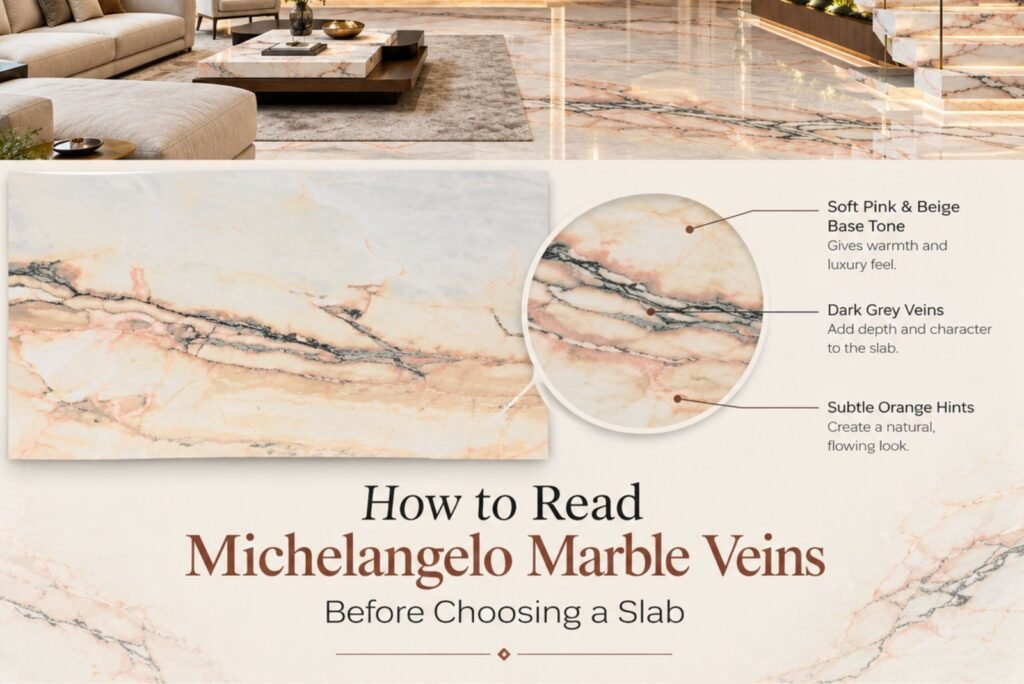
Choosing Michelangelo Marble is not simply about finding a white slab that looks attractive under showroom lights. The real decision begins when you stand in front of a full slab and start looking at its veins, movement, background, surface character and overall balance.
A small sample may look perfect, but a complete slab can reveal a completely different visual story. This is particularly important when selecting marble for a living room floor, feature wall, staircase, kitchen, bathroom or luxury interior where the stone will cover a large visible area.
For buyers looking for Michelangelo Marble in Kishangarh, learning how to read the natural vein pattern before making a selection can make the buying process much easier.
At The Infinity Marble by Bhandari Marble Group, the focus is on helping customers understand the stone rather than choosing only from a small sample. With a family legacy dating back to 1631 and a global natural-stone network serving customers across 100+ countries, the company works with homeowners, architects, designers and project buyers looking for premium marble solutions.
What Makes Michelangelo Marble Veins Important?
The veins are one of the first things people notice in Michelangelo Marble. They influence how the stone looks after installation and determine whether several slabs will appear visually connected.
Natural marble does not behave like a printed tile. Its lines can change direction, become stronger or softer, disappear into the background and reappear elsewhere.
That natural variation is part of the character of the stone.
Before selecting a slab, therefore, do not ask only:
“Is this marble white enough?”
Also ask:
- How strong are the veins?
- Which direction do they travel?
- Are they evenly distributed?
- Do they complement the room?
- Can multiple slabs be matched?
- Will the pattern work after cutting?
- Does the stone still look balanced from a distance?
These questions help turn a beautiful-looking slab into a practical design choice.
Start by Looking at the Slab From a Distance
One common mistake is examining marble from very close to the surface.
Step back several feet and look at the entire slab.
At this distance, you can understand the overall movement of the marble. Some slabs may have delicate, widely spaced veins that create a calm appearance. Others may have more noticeable movement that becomes a strong decorative element.
For a large living-room wall or flooring project, the overall pattern is usually more important than one attractive line.
A vein that looks beautiful from 30 centimetres away may become visually distracting when repeated across several metres.
Follow the Direction of the Veins
Next, trace the main veins with your eyes.
Do they travel:
- diagonally?
- horizontally?
- vertically?
- in several intersecting directions?
- in a loose flowing pattern?
There is no single direction that makes a marble slab suitable for every project. The important point is whether the natural movement works with the architecture.
For example, long diagonal veins can create a sense of movement across a feature wall. More controlled linear movement may work well where the designer wants a quieter visual appearance.
If the marble is being used on a staircase or large wall, vein direction becomes even more important because cutting can change how the pattern is ultimately displayed.
Look at Vein Density, Not Just Vein Colour
Buyers often concentrate on whether the veins are grey, darker grey or slightly warmer in tone.
Colour matters, but density matters just as much.
Compare how much of the slab is occupied by visible veining.
A lightly veined Michelangelo Marble slab may create a clean, understated backdrop. A more expressive slab can become the focal point of the interior.
Think about the rest of the room before choosing.
If the furniture, lighting, wall finishes and architectural details are already elaborate, a quieter marble pattern may create better visual balance.
If the surrounding design is minimal, a slab with stronger natural movement can provide the character the room needs.

Check Whether the Veins Are Naturally Connected
When purchasing multiple slabs, never evaluate every slab as an isolated piece.
Place the slabs beside one another where possible.
Look for:
- continuation of major veins
- compatible background shades
- similar movement
- differences in vein thickness
- changes in overall visual intensity
The objective is not necessarily to make every slab identical. Natural marble will have variation.
The goal is to make sure the slabs belong together visually when installed.
This becomes especially important for large walls, floors, reception areas and other spaces where several slabs remain visible at the same time.
Don’t Ignore the Background White
Michelangelo Marble is often selected because of its elegant white appearance, but white marble is rarely just one flat shade.
Look closely at the background.
Depending on the material, lighting and finish, the white may appear cooler, warmer, brighter or softer.
Place the slab next to the actual interior materials you intend to use.
A marble that looks excellent against showroom lighting may appear different beside warm wooden furniture, beige paint, brass fittings or cool architectural lighting.
For this reason, serious buyers should evaluate the slab under more than one lighting condition whenever possible.
Examine the Veins Across the Entire Slab
A marble vein may start subtly in one corner and become stronger toward the centre.
Another may split into several smaller branches.
Some patterns may have open areas of white between the main veins, while others may have movement distributed across almost the entire surface.
Instead of judging one section, scan the complete slab from top to bottom and left to right.
Ask yourself:
If this entire surface were installed in my room, would I still like the pattern?
That simple question can prevent many selection mistakes.
Think About How the Slab Will Be Cut
A slab is not always installed exactly as you see it in the yard or showroom.
It may be cut into:
- flooring pieces
- stair treads
- wall panels
- vanity tops
- countertops
- bathroom surfaces
- decorative borders
- bookmatched panels
Cutting can change the visual relationship between the veins.
A beautiful central vein may be lost if the slab is divided into small pieces. Conversely, a large open pattern may become more impressive when used as a full-height wall panel.
This is why the intended application should be discussed before final slab selection.
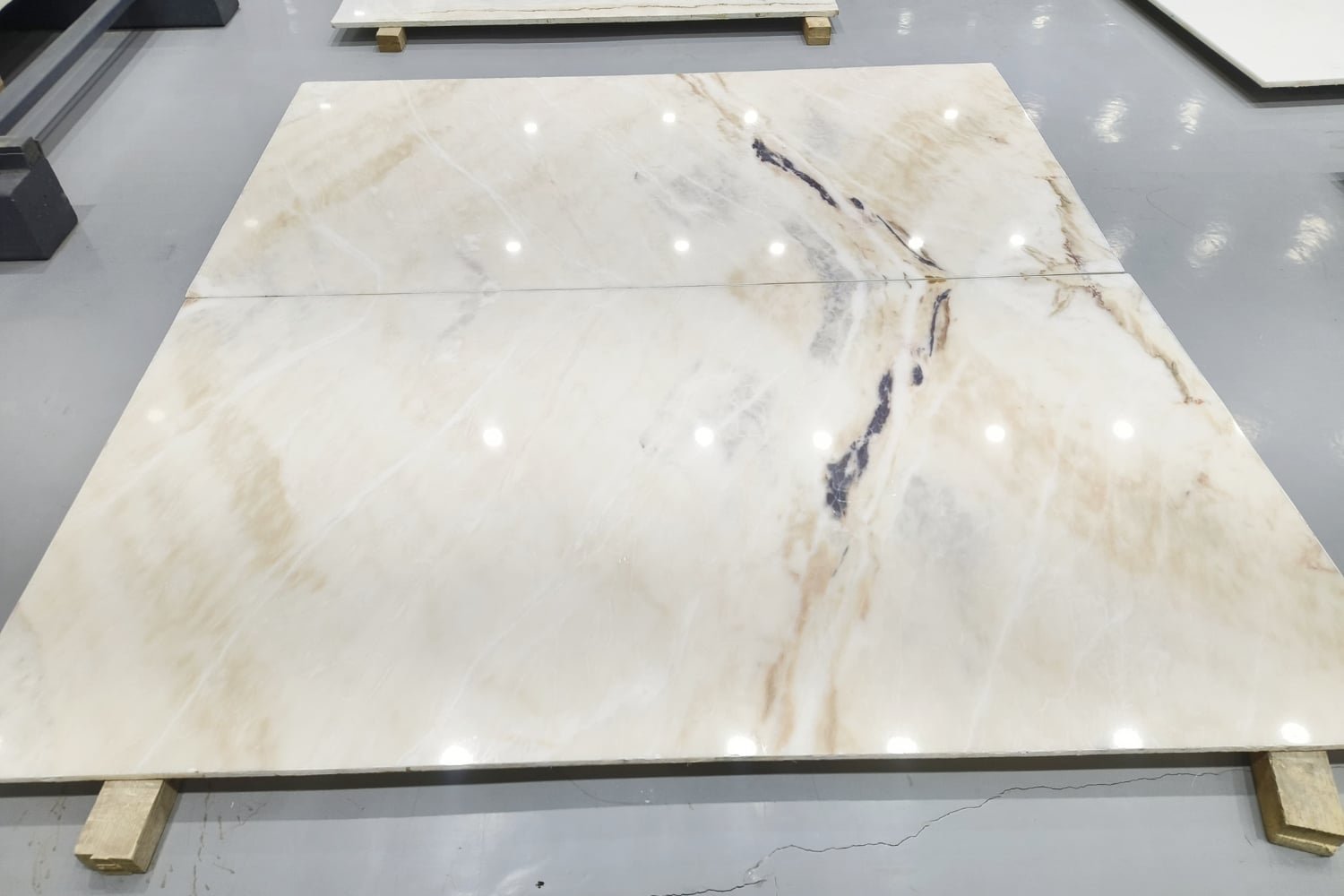
Bookmatching Can Change the Entire Appearance
For feature walls and statement interiors, bookmatching is an important consideration.
Two slabs can be positioned as mirror images so that their natural veins create a symmetrical or flowing visual composition.
However, bookmatching depends heavily on the actual slab pattern.
Not every pair will create the same effect, and forcing a bookmatch where the natural movement does not cooperate can produce an awkward result.
If bookmatching is part of the design, inspect the slabs as a pair rather than selecting them separately.
Don’t Judge Michelangelo Marble Only From a Photograph
Online images are useful for understanding the general appearance of marble, but they cannot completely replace physical slab inspection.
Photography can alter:
- white balance
- vein contrast
- surface brightness
- background colour
- perceived texture
Screen settings can also make two similar stones appear different.
For an important project, seeing the actual slab or receiving accurate current slab images is preferable to selecting solely from a catalogue photograph.
Check the Finish Before Making a Decision
Polished marble can make the white background appear brighter and can increase the visual contrast of the veins.
Other finishes may produce a softer or more subdued appearance.
The same natural stone can therefore create different impressions depending on its finishing treatment.
Always consider the final finish when evaluating the vein pattern.
If the project requires a highly polished luxury appearance, judge the stone with that final finish in mind rather than relying entirely on how an unfinished surface looks.
Look for Natural Variation Rather Than Perfect Uniformity
One of the advantages of natural marble is that each slab has its own character.
Small changes in veining should not automatically be treated as a defect.
Instead, distinguish between natural variation and issues that require technical attention.
Before purchasing, discuss matters such as:
- surface condition
- thickness
- slab dimensions
- edge condition
- repairs or resin treatment, if applicable
- shade variation
- installation requirements
A professional marble supplier should be able to explain these points clearly instead of leaving the buyer to interpret the slab alone.

Match the Marble to the Room, Not the Other Way Around
A common buying mistake is choosing the most dramatic slab simply because it looks impressive in a showroom.
The better approach is to consider the room first.
For a minimalist residence, soft Michelangelo Marble movement may complement the design without overwhelming it.
For a luxury lobby, feature wall or statement staircase, stronger veining may be intentionally desirable.
The right slab depends on how the marble is expected to participate in the overall interior.
A Simple 7-Point Michelangelo Marble Slab Check
Before finalising your slab, take a few minutes to check these seven points:
1. Background:
Is the white tone suitable for the project’s colour palette?
2. Vein direction:
Does the natural movement work with the planned installation?
3. Vein intensity:
Is the pattern subtle enough—or expressive enough—for the room?
4. Slab relationship:
If multiple slabs are required, do they visually work together?
5. Cutting plan:
Will important veins remain visible after fabrication?
6. Lighting:
Does the marble still look appealing under the project’s expected lighting?
7. Final application:
Will the stone look balanced when used on the actual wall, floor, staircase or other surface?
This quick inspection can make slab selection considerably more informed.
Michelangelo Marble in Kishangarh: What Buyers Should Discuss With a Supplier
Kishangarh is a major destination for marble buyers, architects, interior designers and project teams. But visiting a marble market is only the beginning of the selection process.
When considering Michelangelo Marble in Kishangarh, ask the supplier to show you the actual available slabs rather than relying only on a small sample.
Discuss the quantity required, application, preferred background, acceptable vein movement and whether matching or bookmatching is needed.
For large projects, it is also useful to finalise the slab selection before fabrication begins so the cutting plan can be developed around the natural pattern.
Why Full-Slab Selection Matters for White Marble Projects
White marble is particularly sensitive to visual variation because its background creates a large, clean surface where veins remain clearly visible.
A small sample can tell you the basic colour and character of the stone.
A full slab tells you much more:
how the veins travel, where the movement becomes stronger, how much open white space exists and how the complete surface may behave after installation.
That difference matters when buying premium white marble in Kishangarh for a high-visibility project.
Choosing Michelangelo Marble With The Infinity Marble
The Infinity Marble by Bhandari Marble Group focuses on premium natural stone selection for residential, commercial and luxury projects.
With a family legacy since 1631 and an international network serving customers in 100+ countries, the company works with buyers who need more than just a marble name—they need help understanding the material and selecting it according to the project’s design requirements.
For buyers considering Michelangelo Marble, the selection process can include examining slab appearance, natural vein movement, application requirements and the relationship between multiple slabs.
The company also serves customers seeking white marble in Kishangarh and other premium natural stone options.
Customer experiences and 5-star reviews can provide additional insight into a supplier’s service, communication and project-handling experience, although the actual marble should always be evaluated according to the specific project requirements.
Final Thoughts
Reading Michelangelo Marble veins is really about learning to look beyond the colour of the stone.
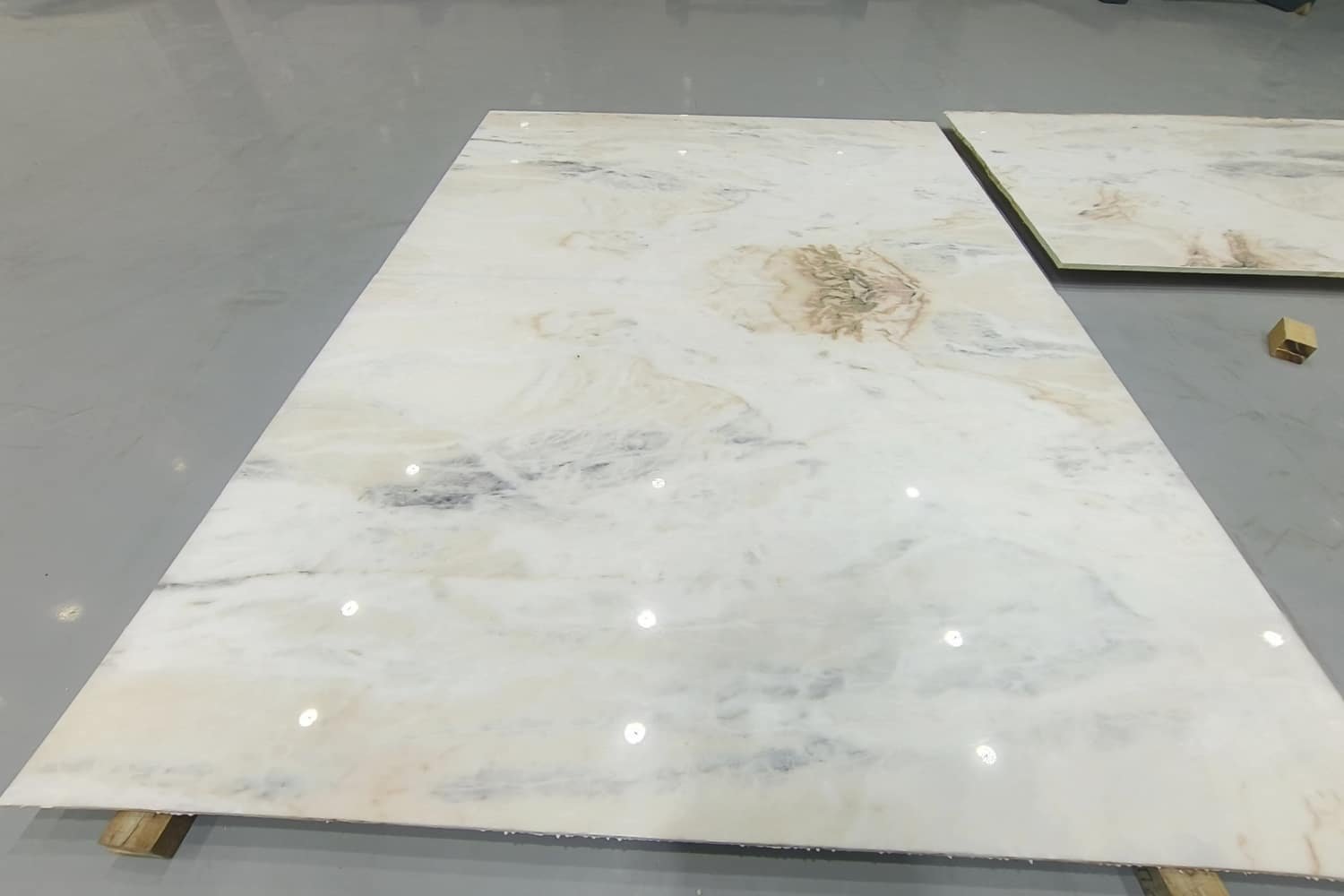
Study the entire slab. Follow the movement. Compare the background. Think about lighting and cutting. If several slabs are needed, examine how they relate to one another. Most importantly, consider how the natural pattern will appear after installation rather than judging the stone only inside the showroom.
When these details are checked before purchase, choosing Michelangelo Marble becomes a more informed design decision—and the natural character of the marble can become one of the strongest elements of the finished space.
About The Infinity Marble
The Infinity Marble by Bhandari Marble Group carries a family legacy dating back to 1631 and serves marble and natural stone requirements across international markets. The company works with homeowners, architects, interior designers and project buyers looking for premium marble and natural stone.
Michelangelo Marble | White Marble in Kishangarh | Imported Marble
Phone: +91 8980000111
Email: bhandarimarblegroup@gmail.com
FAQs About Reading Michelangelo Marble Veins
Can two Michelangelo Marble slabs from the same lot look different?
Yes. Natural marble can show differences in vein movement, density and background tone. This is why checking the actual slabs is important when several pieces are required for one project.
Should I choose a slab with fewer veins for a small room?
Not necessarily. A lightly veined slab can create a quieter appearance, while stronger movement can add a focal point. The choice should depend on the room’s design, furniture and intended visual effect.
How can I tell whether marble veins will look good after cutting?
Ask the supplier or fabricator to review the proposed cutting layout on the actual slab. This helps identify which veins will remain visible and where the major natural movement will appear.
Is a darker vein automatically a sign of better Michelangelo Marble?
No. Vein colour or strength alone does not determine whether a slab is appropriate. The overall appearance, material quality, application and design requirements should all be considered.
Can Michelangelo Marble be used for a feature wall?
Yes, marble with attractive natural movement can be particularly effective on feature walls. Large-format installation can allow the vein pattern to remain visible instead of breaking it into many small pieces.
What should I photograph when shortlisting a marble slab?
Take a full-slab photograph as well as closer images of the major veins, corners and any areas that appear different. Full-slab images are particularly useful when comparing multiple options later.
Should I select marble before finalising the interior design?
Ideally, the marble and interior palette should be considered together. The selected stone can influence wall colours, furniture finishes, lighting temperature, metal accents and the overall visual balance of the space.
Does polished finishing make Michelangelo Marble veins more noticeable?
A polished surface can increase brightness and make natural patterns appear more pronounced. The final visual effect should therefore be considered when assessing the slab before purchase.
How many slabs should I inspect before deciding?
There is no fixed number. Inspect enough slabs to understand the available range of background tones and vein patterns, particularly when the project requires several matching or visually compatible pieces.
What is the biggest mistake buyers make when selecting veined white marble?
One frequent mistake is judging the stone from a small sample or a single close-up photograph. A full-slab view provides a much better understanding of the marble’s actual movement and overall character.