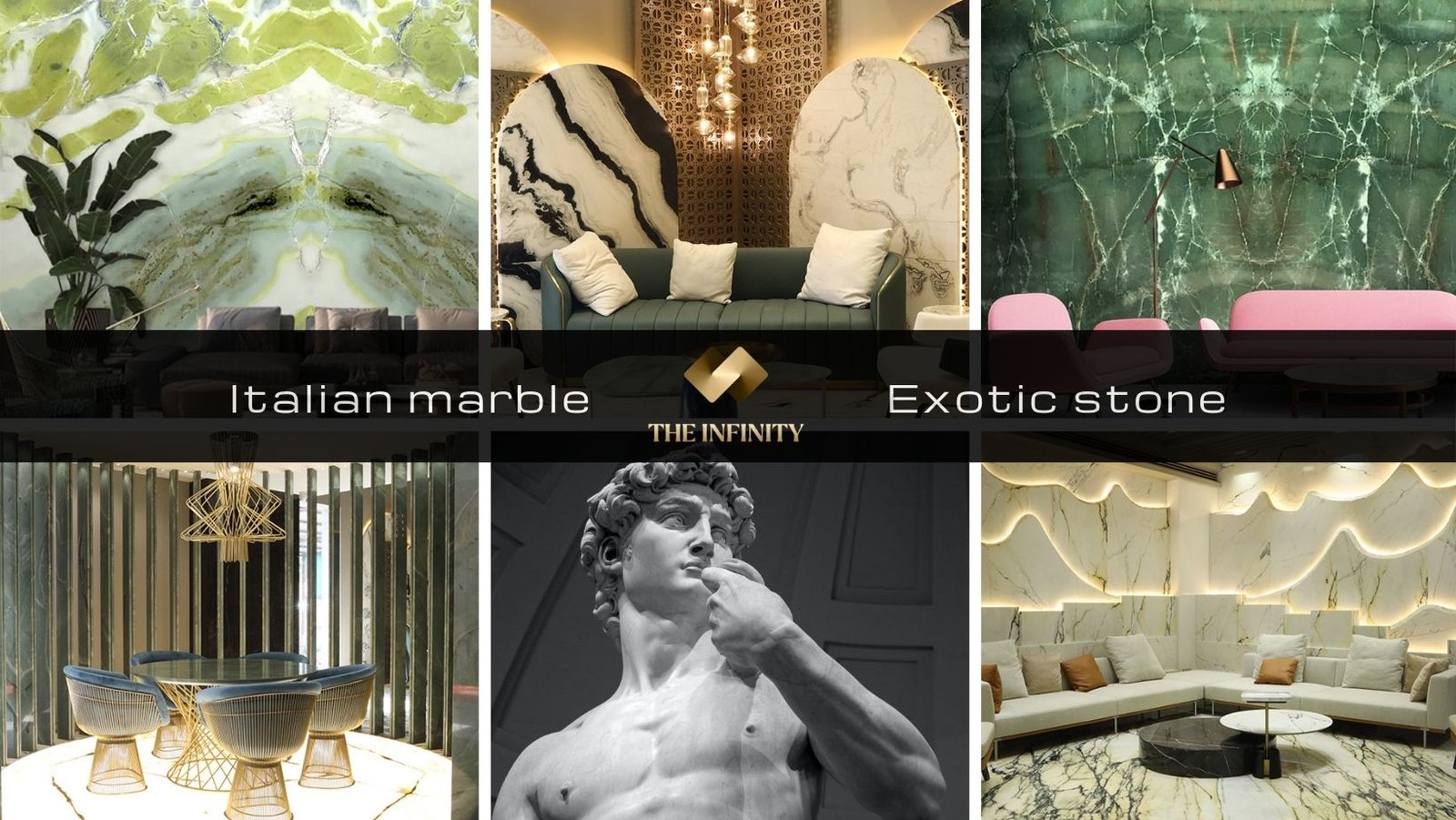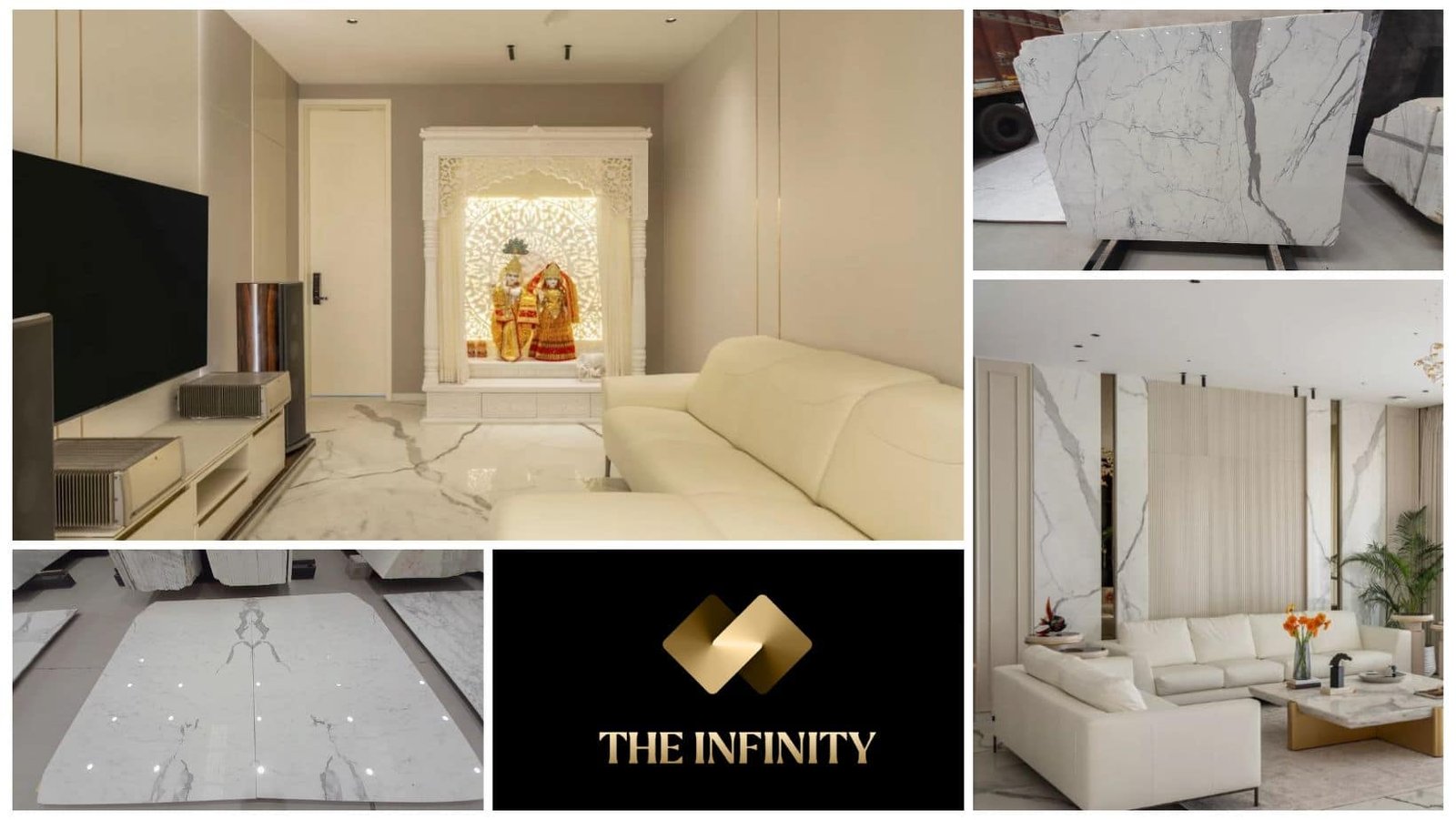

Statuario marble is valued for its luminous white background and distinctive grey veining, making it a popular choice for sophisticated residential and commercial interiors. However, achieving a refined result with Statuario Marble is not simply about selecting an attractive slab. The way the marble is planned around doors, windows, arches, niches, columns, staircases, and other architectural openings can significantly influence the overall appearance of a space.
Thoughtful planning helps preserve the natural movement of the stone while reducing awkward cuts, unnecessary joints, and visual interruptions. It also allows designers and homeowners to use the veining as an intentional part of the architecture rather than treating every slab as an independent surface.
For buyers looking for Statuario Marble in Kishangarh, The Infinity Marble by Bhandari Marble Group offers a broad natural-stone selection supported by a family legacy dating back to 1631. The group combines generations of marble experience with a global export network serving customers across 100+ countries.
Why Architectural Planning Matters When Using Statuario Marble
Statuario marble often contains prominent veins that naturally attract attention. If these veins are interrupted randomly around an opening, the finished surface can look visually fragmented.
Architectural planning allows the stone pattern to work with the structure.
For example, a large wall containing a doorway can be planned so that the strongest vein travels naturally toward or across the opening. Similarly, marble around a window can be selected and cut to maintain a balanced relationship between the two sides.
Before fabrication begins, consider:
- The location and dimensions of every opening
- Slab size and available material
- Vein direction
- Bookmatching requirements
- Edge details
- Corner conditions
- Door and window frames
- Lighting
- Electrical and plumbing points
- Future maintenance requirements
This early coordination can make the installation more precise and help maximize the visual value of premium Statuario marble.
Start With the Architectural Drawing
One of the most important steps is to plan the marble after the architectural dimensions have been finalized.
Instead of choosing marble first and deciding how to cut it later, the design team should understand the complete wall elevation. Mark the locations of doors, windows, niches, columns and other interruptions.
A detailed elevation can show:
- Finished wall dimensions
- Opening heights and widths
- Marble panel sizes
- Joint positions
- Vein orientation
- Slab transitions
- Edge profiles
- Skirting levels
This approach is particularly useful for large feature walls where the natural pattern of Statuario marble is intended to become a major design element.
Plan the Veining Around Door Openings
Doorways create one of the most common interruptions in marble wall installations.
For a simple contemporary interior, the marble can be arranged with relatively consistent vertical or horizontal movement. In a more luxurious design, the veining can be deliberately aligned around the doorway.
The surrounding marble should be reviewed as a complete composition rather than as separate pieces.
For wide entrances, designers may consider:
Continuous Vein Direction
The slabs can be positioned so that the dominant vein direction remains consistent around the opening.
Framed Doorway
A contrasting or carefully selected marble border can visually define the doorway while separating it from the main wall surface.
Feature Panel
The wall can be divided into large marble panels, with the doorway incorporated into the panel layout.
The appropriate approach depends on the architectural style, slab characteristics and desired visual effect.
Using Statuario Marble Around Windows
Windows naturally divide a wall into multiple sections. This makes them especially important when working with strongly veined marble.
If the window is centered, the marble on both sides can be selected for visual balance. Where the design uses bookmatched or mirrored slabs, the window position should be considered before the slabs are cut.
For larger windows, pay attention to:
- Vertical vein movement
- Symmetry
- Sill detailing
- Corner transitions
- Window frame material
- Natural daylight direction
Daylight can make Statuario marble appear different throughout the day. A vein that looks subtle under showroom lighting may become more prominent when exposed to direct sunlight.
Planning Marble Around Arches
Arched openings require additional fabrication planning because straight rectangular pieces cannot always follow the curved geometry efficiently.
Before fabrication, the exact arch template should be confirmed.
For an elegant marble arch, the design team may use:
- Carefully cut curved pieces
- Segmented voussoir-style arrangements
- A contrasting border
- Large-format marble with strategically positioned joints
The choice depends on the radius of the arch, slab dimensions, marble thickness and fabrication capabilities.
With Statuario marble, the direction of the veins should also be considered so the curves do not make the natural pattern appear unintentionally disjointed.
Statuario Marble Around Niches
Wall niches are increasingly used in luxury living rooms, bathrooms, bedrooms and hospitality interiors.
A niche can become a small focal point when its interior and surrounding wall are coordinated correctly.
For example, the same Statuario marble may be used across:
- The niche back panel
- Side walls
- Shelf
- Surrounding feature wall
However, the stone should not necessarily be cut from random slab areas. Selecting sections with complementary veining can make the niche feel integrated with the larger surface.
Columns and Structural Elements
Columns can either interrupt a marble pattern or become an intentional architectural feature.
If a column is being clad in Statuario marble, the stone should be planned around its geometry before cutting.
For rectangular columns, matching the vein direction across adjacent faces can produce a more continuous appearance.
For curved columns, smaller pieces or specialized fabrication may be required.
The goal is not always to eliminate every joint. Instead, joints should appear intentional and work with the geometry of the column.
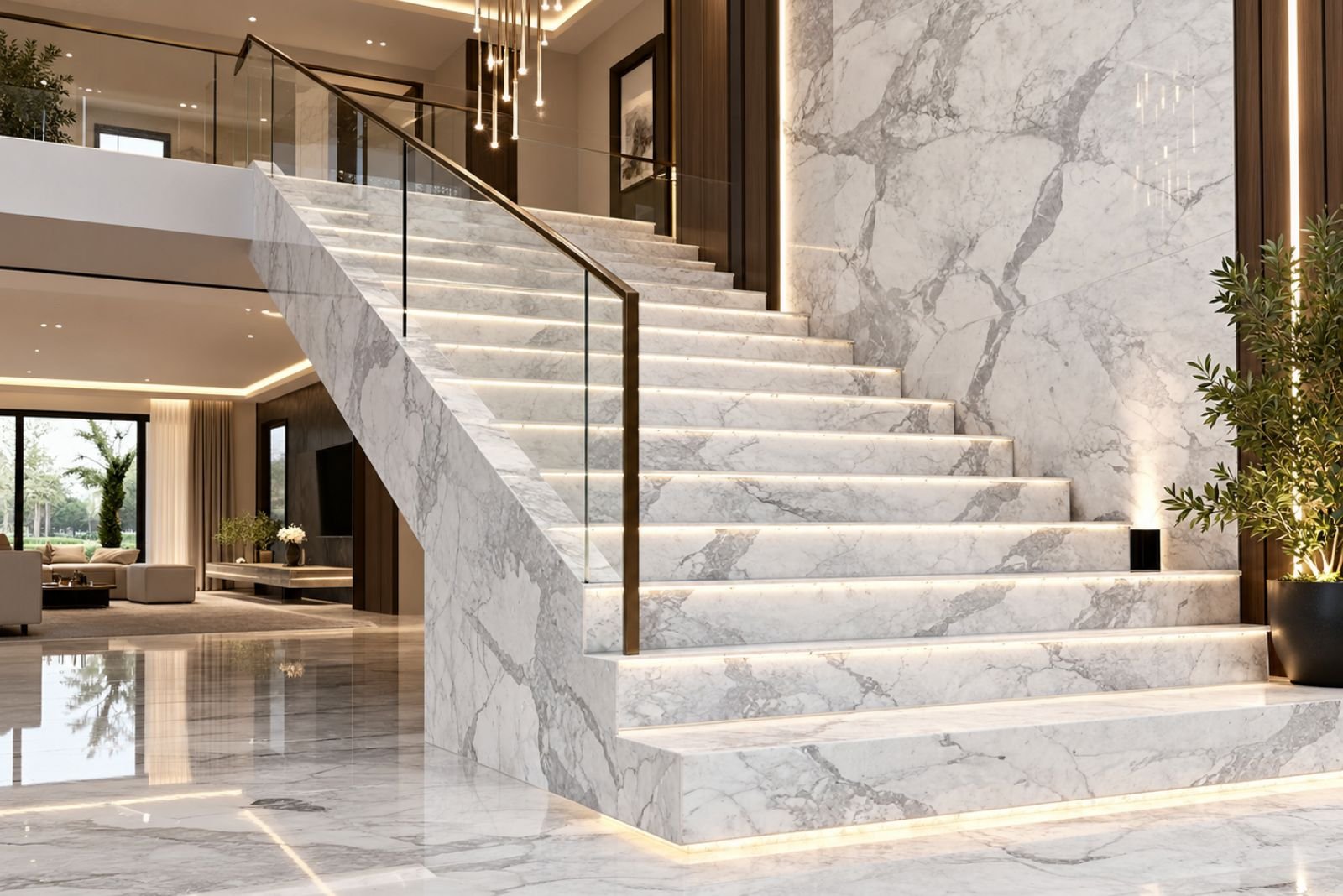
Staircases Require Detailed Marble Planning
Staircases combine horizontal and vertical surfaces, making them more complex than ordinary wall applications.
When Statuario marble is used for stairs, coordinate:
- Treads
- Risers
- Landings
- Stringers
- Skirting
- Handrail zones
- Adjacent walls
The natural veining can be oriented to create a consistent visual rhythm from one step to another.
Large landings can also provide opportunities to showcase particularly attractive sections of the slab.
Bookmatching Statuario Marble Near Openings
Bookmatching is a technique where two adjacent marble slabs are placed so their veining creates a mirrored appearance.
This can be particularly effective on feature walls.
However, architectural openings must be incorporated into the bookmatch layout before fabrication. A door, window or niche placed through the center of a bookmatched composition can dramatically affect the visual balance.
For this reason, bookmatched marble should be planned using the actual slab selections rather than relying only on generic drawings.
How to Reduce Waste During Marble Planning
Premium marble should be planned carefully because complicated openings can generate significant offcuts.
A professional cutting plan can help identify which slab sections should be allocated to:
- Main feature panels
- Door surrounds
- Window areas
- Niches
- Skirting
- Stair components
- Smaller architectural details
Good planning can improve material utilization without compromising the design.
However, minimizing waste should not mean using unsuitable pieces in highly visible locations. Visual consistency remains important when working with a premium natural stone.
Coordinate Marble With Door and Window Frames
The final appearance depends on more than marble alone.
Door and window frames can be made from wood, metal, stone or other materials. Their color, thickness and profile should complement the Statuario marble.
A slim frame can create a contemporary appearance, while a substantial stone surround may produce a more traditional architectural effect.
Before installation, confirm the final frame dimensions so that marble cuts do not need to be altered unnecessarily.
Lighting Can Change the Appearance of Statuario Marble
Lighting deserves attention during marble planning.
Warm artificial lighting can make the white background appear softer, while cool lighting may emphasize the crispness of the stone.
Linear lighting placed close to a marble wall can also highlight natural surface variation and veining.
For feature walls containing openings, lighting should be positioned so that the marble remains visually balanced on both sides of doors, windows or niches.
Selecting the Right Statuario Slabs
Every natural marble slab is different. Even stones from the same category can vary in background tone, vein thickness, movement and overall character.
When selecting Statuario marble, review multiple slabs together rather than approving a single isolated sample.
Pay particular attention to:
- Background whiteness
- Grey vein pattern
- Vein density
- Movement
- Surface finish
- Slab dimensions
- Thickness
- Natural characteristics
This becomes especially important when several slabs will be installed together around architectural openings.
Why Kishangarh Is Important for Marble Buyers
Kishangarh is widely recognized as a major marble and natural-stone hub in Rajasthan, offering access to a wide range of domestic and imported stones.
For customers searching for Statuario Marble in Kishangarh or white marble in Kishangarh, working with an experienced supplier can make slab selection, inspection, processing and project coordination easier.
The Infinity Marble by Bhandari Marble Group brings generations of family experience to natural stone sourcing and supply. Its stated family legacy dates back to 1631, alongside a global export network serving customers in more than 100 countries.

Why Choose The Infinity Marble by Bhandari Marble Group?
The Infinity Marble focuses on premium marble and natural-stone solutions for residential, hospitality and architectural projects.
Its experience can be useful when a project requires careful coordination between marble selection and architectural detailing.
Key strengths include:
- Family legacy since 1631
- Experience in marble and natural stone
- Statuario marble selection
- White marble collections
- Architectural project support
- International export network
- Service across 100+ countries
- Focus on premium natural-stone applications
Customers can also consider verified 5-star customer reviews when evaluating the supplier and its service experience.
A Practical Checklist Before Cutting Statuario Marble
Before fabrication starts, confirm the following:
- Final architectural drawings are approved.
- Door and window dimensions are confirmed.
- Marble slab measurements have been verified.
- Vein direction has been selected.
- Bookmatching requirements are finalized.
- Visible joints are planned.
- Corners and edges are detailed.
- Niches and openings are included in the cutting layout.
- Lighting positions have been coordinated.
- Extra material has been allowed for fabrication and installation.
This checklist can prevent many avoidable changes during installation.
Final Thoughts
Planning Statuario marble around architectural features is a combination of material selection, geometry, fabrication and design coordination. Doors, windows, arches, niches, columns and staircases should be considered part of the marble composition rather than obstacles placed within it.
When the slab pattern, architectural openings and installation details are coordinated from the beginning, Statuario marble can create a more cohesive and sophisticated interior.
For projects requiring Statuario Marble in Kishangarh, The Infinity Marble by Bhandari Marble Group offers premium marble and natural-stone solutions backed by a family legacy dating to 1631 and an international export network serving 100+ countries.
Contact The Infinity Marble / Bhandari Marble Group
Phone: +91 8980000111
Email: bhandarimarblegroup@gmail.com
Frequently Asked Questions About Planning Statuario Marble Around Openings
1. How should Statuario marble be planned around a doorway?
Start with the complete wall elevation and determine the doorway’s exact dimensions. Then position the marble slabs so the dominant veining remains visually balanced around the opening.
2. Can Statuario marble be used around windows?
Yes. Statuario marble can be used around windows, including walls, reveals, sills and surrounding feature panels. The slab layout should account for the window position and natural vein movement.
3. Is bookmatching suitable for a Statuario marble feature wall?
Bookmatching can work very well for feature walls where the natural veining is strong. The location of doors, windows and niches should be incorporated into the bookmatch layout before fabrication.
4. How do I avoid awkward marble joints around architectural openings?
Use a detailed cutting layout before fabrication. Position joints according to the architectural geometry and slab dimensions instead of allowing them to occur randomly around openings.
5. Should marble veins run vertically or horizontally?
There is no universal direction. The appropriate orientation depends on the wall proportions, architectural design, slab characteristics and desired visual effect.
6. Can Statuario marble be used around curved arches?
Yes. Curved applications require accurate templates and specialized fabrication. The vein direction should be considered alongside the arch geometry.
7. How many Statuario marble slabs are needed for a feature wall?
The quantity depends on the wall dimensions, slab sizes, openings, cutting pattern and desired vein matching. A detailed measurement and cutting plan provides a more accurate estimate.
8. Does natural light affect the appearance of Statuario marble?
Yes. Daylight can change how the white background and grey veining appear at different times of the day. Lighting conditions should therefore be considered when selecting and positioning slabs.
9. Can the same Statuario marble be used on walls and stairs?
Yes, provided the selected material, thickness, fabrication method and installation details are appropriate for each application. The vein direction can be coordinated to create visual continuity.
10. What should I check before ordering Statuario Marble in Kishangarh?
Review the actual slabs, background tone, vein characteristics, dimensions, thickness, finish, quantity and intended application. For large projects, approve the complete slab layout before cutting.
11. Is Statuario marble suitable for luxury interiors?
Its bright background and expressive veining make Statuario marble a popular choice for high-end architectural interiors, including feature walls, bathrooms, floors, staircases and selected furniture applications.
12. Where can I find Statuario Marble in Kishangarh?
Kishangarh has a substantial marble and natural-stone market. Buyers can evaluate suppliers based on slab selection, material quality, fabrication capabilities, project experience and customer service. The Infinity Marble by Bhandari Marble Group offers Statuario and other premium marble collections.
13. Why is slab inspection important before installation?
Natural marble varies from slab to slab. Inspecting the actual slabs helps the project team understand the background, veins, movement and natural characteristics before final cutting and installation.
14. Can marble planning reduce material wastage?
Yes. A detailed slab layout can allocate suitable sections to major panels and smaller architectural elements, potentially improving material utilization while maintaining visual consistency.
15. What makes Statuario marble different from ordinary white marble?
Statuario is generally recognized for its white to bright background combined with distinctive grey veining. The exact appearance varies naturally between individual slabs, which is why physical slab selection is important.