

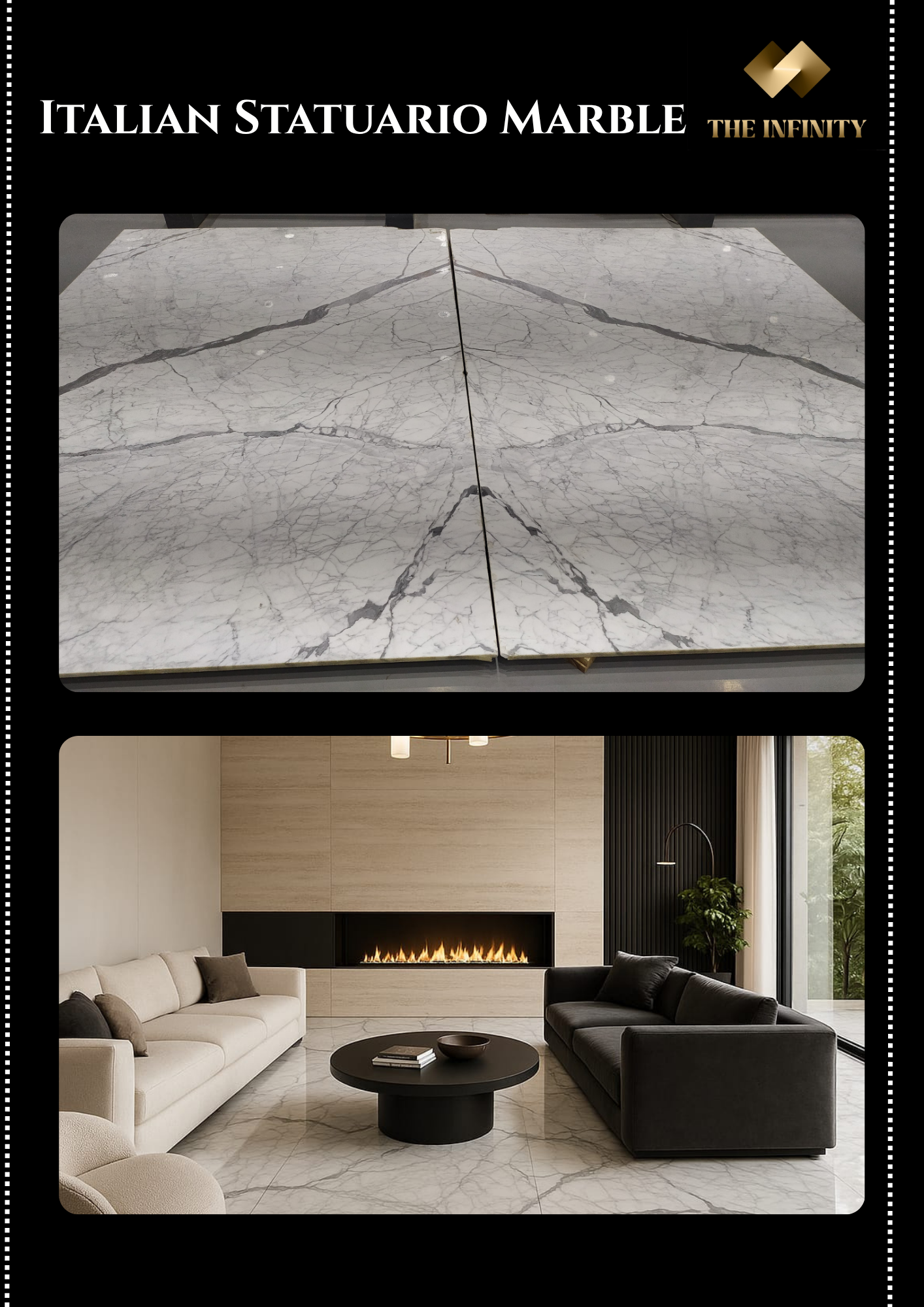
Bookmatched marble can completely change the character of an interior. When two adjoining marble slabs are opened like the pages of a book, their veins create a mirrored pattern that can become the main visual feature of a wall, floor, staircase, kitchen, or luxury living space.
But choosing bookmatched marble is not simply about selecting two slabs that look similar. The direction of the veins, background colour, slab size, thickness, surface quality, and final installation all influence how the finished design will appear.
For homeowners, architects, and interior designers looking for premium natural stone, understanding these details before purchasing can make slab selection much easier.
What Is Bookmatched Marble?
Bookmatching is a method in which two marble slabs are placed next to each other so their natural veining creates a mirror-like effect.
The result can look almost like a continuous artwork across the surface. Since marble is a natural material, however, the matching will not always be perfectly symmetrical. Small differences in movement, mineral markings, tone, and veining are part of the stone’s natural character.
This is why selecting the actual slabs is more important than choosing only a marble name from a catalogue.
Start With the Space, Not Just the Marble
Before selecting a bookmatched pair, decide where the marble will be installed.
A dramatic pattern may work beautifully on a large living-room feature wall but feel visually crowded in a compact space. Similarly, highly active veining may be attractive for a fireplace backdrop while a quieter pattern may suit a complete floor.
Consider:
- Wall dimensions
- Available natural and artificial lighting
- Furniture placement
- Ceiling height
- Existing colours
- Required number of slabs
- Direction in which the marble will be installed
This gives you a better idea of how much visual movement the room can accommodate.
Look at the Vein Direction Carefully
Veining is the heart of bookmatched marble.
When viewing slabs, don’t look at each piece independently. Place the two slabs together mentally—or physically where possible—and examine how the veins travel from one side to the other.
Look for:
- Strong central veins
- Fine branching patterns
- Cloud-like movement
- Contrasting mineral lines
- Changes in background tone
- Natural continuation between adjoining slabs
A good bookmatch should make sense as a composition when the slabs are installed together.
Check the Background Colour Before Finalising
Two slabs from the same marble variety can have noticeably different backgrounds.
White marble may range from crisp white to warm ivory or slightly grey tones. The difference can become more noticeable when large slabs are installed beside one another.
This is particularly important when choosing varieties such as Statuario Marble, Carrara Marble, Volakas Marble, Michelangelo Marble, Calacatta Gold Marble, Thassos White Marble, or Dover White Marble.
Rather than judging a small sample, inspect the complete slabs whenever possible.
Slab Size Matters More Than Many Buyers Expect
Bookmatching requires enough surface area for the design to be visible.
If the wall is large but the selected slabs are too small, the intended visual impact may be interrupted by additional joints. On the other hand, oversized slabs can require careful handling, transportation, and installation planning.
Before purchasing, share accurate measurements of the area with your marble supplier. This helps determine:
- How many slabs are required.
- Which slabs should be paired.
- Where joints may fall.
- How much cutting will be necessary.
- Whether the desired pattern can be maintained after installation.
Inspect the Slabs for Natural Characteristics
Natural marble is not manufactured to look identical from one piece to another. Variations are expected.
Before approval, inspect the slabs for:
- Fissures and natural lines
- Resin-filled areas
- Mineral deposits
- Surface consistency
- Edge condition
- Thickness variation
- Shade differences
- Vein continuity
Not every natural mark is a defect. The important point is understanding the stone’s characteristics and deciding whether they suit the intended application.

Match the Marble With Your Interior Style
The right bookmatched marble should complement the architecture rather than compete with everything around it.
For a sophisticated contemporary interior, a restrained white marble with controlled grey movement can create a calm backdrop. A more dramatic marble with bold veining can become a statement feature in an otherwise understated room.
Bookmatched marble can be considered for:
- Luxury living-room walls
- TV feature walls
- Bedroom headboards
- Fireplace surrounds
- Entrance walls
- Staircase backdrops
- Dining areas
- Reception spaces
- Boutique-style bathrooms
- Feature flooring
The application should determine the marble’s visual intensity.
Pay Attention to Lighting
Lighting can significantly change how marble appears.
Natural daylight may reveal subtle grey or warm undertones, while spotlights can emphasise particular veins and surface movement. If the marble is being used on a feature wall, discuss lighting placement before installation.
For a dramatic bookmatch, directional lighting can highlight the natural pattern. For softer interiors, diffused lighting may preserve the overall calm appearance of the stone.
Ask for Slab Pairing Before You Buy
One of the most important questions to ask a supplier is whether the slabs have been selected specifically for bookmatching.
A pair should be evaluated together rather than simply selecting two slabs of the same marble variety.
At The Infinity Marble by Bhandari Marble Group, buyers looking for imported marble in Kishangarh can discuss their project dimensions, preferred marble type, vein movement, and intended application before final slab selection.
For customers searching for Statuario Marble in Kishangarh or other varieties of Italian marble in Kishangarh, this type of project-specific selection can be particularly useful for large feature surfaces.
Don’t Ignore Installation Planning
Even beautiful slabs can lose their impact if installation is poorly planned.
Before work begins, the installer should understand:
- Which slab goes on which side
- Where the central joint will fall
- The intended vein direction
- Cutting requirements
- Edge finishing
- Adhesive and fixing requirements
- Final polishing or surface treatment
The slabs should ideally be dry-laid or carefully mapped before permanent fixing wherever the project allows it.
Choose Marble According to the Visual Effect You Want
Different marble varieties create different design moods.
Statuario Marble is often selected for its bright background and distinctive grey veining.
Italian Carrara Marble can offer a softer, more understated appearance with delicate grey movement.
Volakas Marble is known for its white base and characteristic grey veining, making it suitable for elegant interior applications.
Michelangelo Marble can provide dramatic movement where a stronger natural pattern is desired.
Calacatta Gold Marble is considered when warm gold-toned veining is preferred alongside a light background.
Thassos White Marble is useful when the design calls for a cleaner, brighter white appearance.
Dover White Marble can suit interiors where a softer white stone aesthetic is desired.
The choice should ultimately depend on the architectural design, lighting, maintenance expectations, and the appearance you want after installation.
Why Kishangarh Is Important for Bookmatched Marble Buyers
Kishangarh is widely recognised as an important marble trading and processing centre, giving buyers access to a broad range of natural and imported marble options.
For someone comparing white marble in Kishangarh, imported marble, or premium Italian varieties, having access to multiple slabs makes visual comparison much easier.
Instead of deciding from photographs alone, buyers can examine actual slabs, compare backgrounds, study vein movement, and select combinations suitable for their project.
A Simple Checklist Before You Finalise Your Slabs
Before placing an order, check these points:
- Have you seen the complete slabs?
- Are the slabs suitable for bookmatching?
- Does the vein direction work with your wall or floor?
- Are the backgrounds sufficiently compatible?
- Is the slab size suitable for your measurements?
- Have natural characteristics been discussed?
- Has the installation pattern been planned?
- Have lighting conditions been considered?
- Is the required quantity available from a compatible lot?
- Has the final slab pairing been approved?
Taking care of these details before purchase can prevent expensive design changes later.
Bookmatched Marble Is About Selection as Much as Stone
The beauty of bookmatched marble comes from combining two naturally formed pieces into one visual composition. That means the best result depends on more than choosing a premium marble variety.
The actual slabs, their relationship with one another, the room’s dimensions, lighting, installation method, and surrounding design all matter.
For homeowners and professionals sourcing Statuario Marble in Kishangarh, imported marble in Kishangarh, or other premium Italian marble varieties, careful slab selection is one of the most important steps in achieving a refined finished interior.
The Infinity Marble by Bhandari Marble Group offers a range of natural and imported marble options for residential and luxury interior projects. Buyers can discuss their project requirements and marble preferences for suitable slab selection.
Contact: +91 8980000111
Email: bhandarimarblegroup@gmail.com
Frequently Asked Questions
1. Can any two marble slabs be used for bookmatching?
Not necessarily. The slabs need to have compatible vein movement and should be selected as a pair. Two slabs from the same marble category can still have very different patterns.
2. Should I select the marble before designing the feature wall?
For a prominent bookmatched wall, selecting the actual slabs early can be helpful. The natural vein pattern can then influence the positioning, lighting, furniture, and overall composition.
3. Is bookmatched marble suitable for a small room?
Yes, but the pattern should be chosen carefully. A calmer vein structure can prevent a smaller room from appearing visually overloaded, while a dramatic pattern can be reserved for one controlled focal area.
4. How can I know where the bookmatch joint will appear?
The installer or fabricator should map the slabs against the actual dimensions before cutting. This helps establish the centre line, edges, openings, and required cuts before installation.
5. Does polishing change the appearance of bookmatched marble?
Polishing can increase the depth and contrast of the marble’s natural colours and veins. It is therefore useful to consider the final finish when approving the slabs rather than judging them only in an unfinished state.
6. Is a bookmatched pair always perfectly symmetrical?
No. Natural marble is formed by geological processes, so the two sides may show slight differences. These variations are part of the character of natural stone rather than an indication that the slabs are manufactured products.
7. What should I send a marble supplier before asking for slab suggestions?
Project dimensions, photographs of the space, application details, preferred colour family, approximate quantity, and your desired visual style can help the supplier understand what type of slabs may work for the project.
8. Is bookmatching only used with Statuario Marble?
No. Bookmatching can be created with many marble varieties where the natural pattern and slab characteristics allow a visually effective pairing. The final suitability depends on the individual slabs.
9. Should I choose marble from photographs online?
Photographs are useful for initial research, but final selection is better made after viewing the actual slabs. Screen settings, lighting, photography, and natural variation can affect how marble appears in an image.
10. What is the biggest mistake when buying bookmatched marble?
Choosing slabs independently instead of evaluating them as one composition is a common issue. For bookmatching, the relationship between the two slabs is just as important as the appearance of each individual slab.
Final Thoughts
Choosing bookmatched marble is a design decision as much as a material decision. Start with your space, understand the required slab dimensions, study the natural vein movement, compare complete slabs, and plan installation before cutting begins.
Whether you are considering Statuario Marble, Carrara Marble, Volakas Marble, Michelangelo Marble, Calacatta Gold Marble, Thassos White Marble, or Dover White Marble, the right slab pairing can turn an ordinary surface into a distinctive architectural feature.
For premium Imported marble in Kishangarh, imported marble, and white marble in Kishangarh, thoughtful selection remains the key to achieving a balanced and luxurious result.