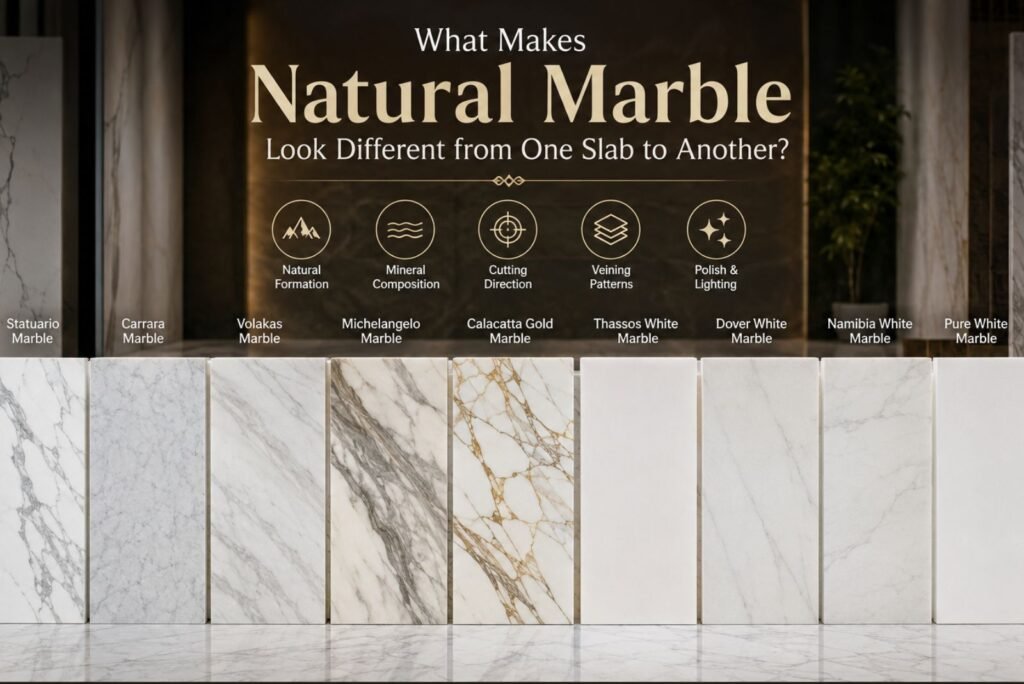
Natural marble is valued precisely because no two pieces are guaranteed to look exactly alike. Even when slabs come from the same quarry, the same marble variety, or the same block, their colour, veining, movement, crystal patterns, and background can vary noticeably.
This natural variation is especially important when selecting premium stones such as Statuario Marble in Kishangarh, Carrara Marble, Volakas Marble, Michelangelo Marble, Calacatta Gold Marble, Thassos White Marble, Dover White Marble, Namibia White Marble, and Pure White Marble.
For homeowners, architects, and interior designers, understanding why slabs differ makes the selection process much easier. Instead of expecting every slab to look identical, you can choose the particular piece whose natural character suits your project.
Marble Is a Natural Material, Not a Manufactured Surface
One of the biggest differences between marble and factory-made surfaces is how they are formed.
Natural marble develops underground over extremely long periods through geological processes involving heat, pressure, minerals, and changes within the earth. During this formation, different minerals and impurities become part of the stone.
That is why a slab can contain:
- Fine or bold veins
- Different shades of white or cream
- Grey, beige, golden, or darker mineral lines
- Cloud-like movements
- Small natural markings
- Variations in crystal structure
- Changes in background consistency
These characteristics are not necessarily imperfections. In many premium marble varieties, they are part of what makes the stone visually distinctive.
Why Two Slabs from the Same Marble Can Look Different
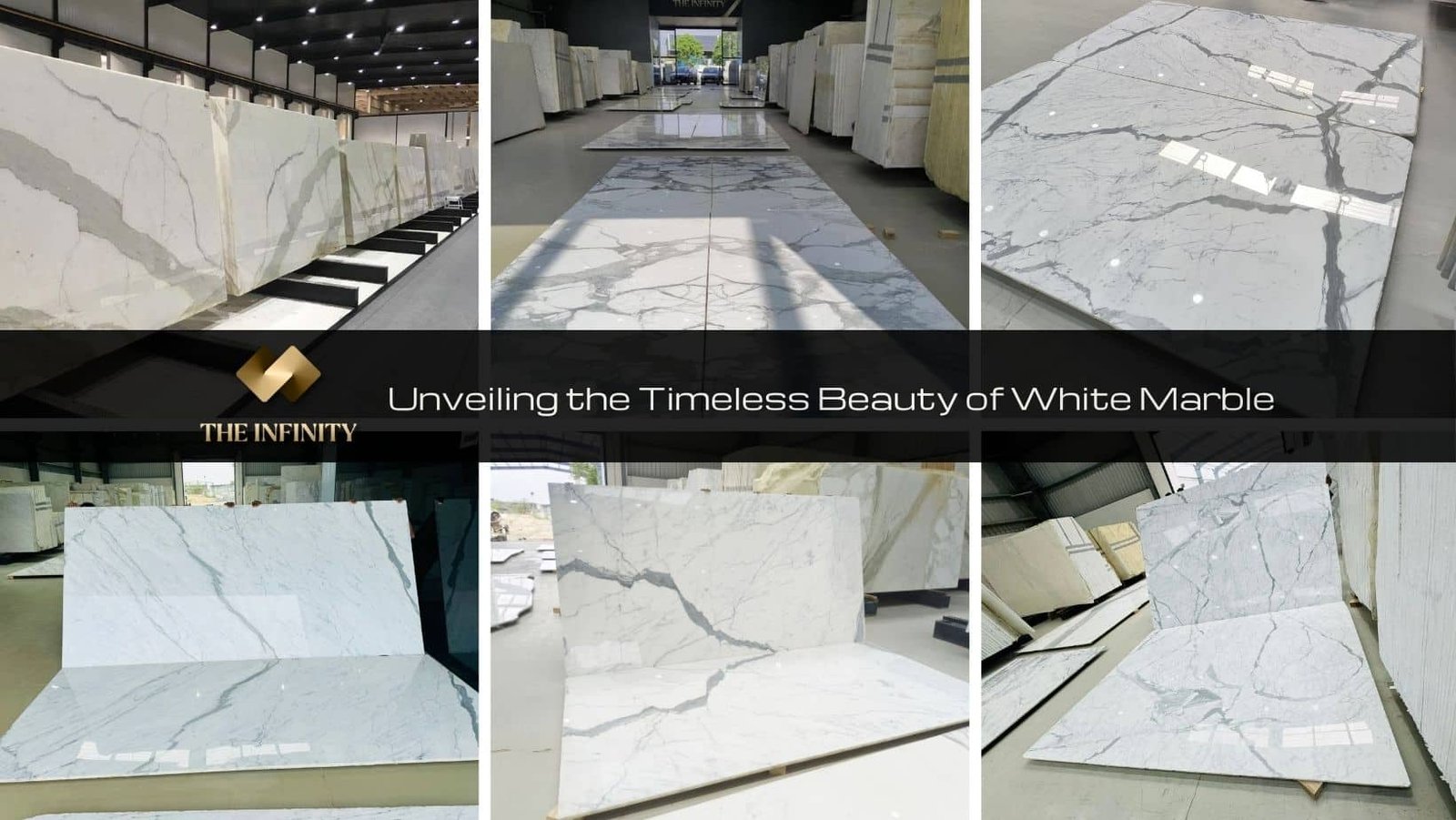
Suppose you are comparing several slabs of Statuario Marble in Kishangarh. You may notice that one slab has dramatic grey veining while another has softer lines and a cleaner white background.
This can happen because each section of the original marble block contains a slightly different distribution of minerals and natural structures.
Even slabs cut from the same block may not display the exact same pattern. The cutting direction can also influence how the internal veins appear on the finished surface.
This is one reason experienced marble buyers look at the actual slabs, rather than selecting stone purely from a small sample or photograph.
The Role of Mineral Composition
Minerals have a major influence on marble’s appearance.
Different minerals can create different colours and patterns within the stone. For example, grey veining can produce a cool architectural appearance, while golden or warmer mineral movement can give a marble a richer character.
This becomes particularly noticeable in varieties such as:
- Statuario Marble – known for distinctive veining against a light background
- Italian Carrara Marble – commonly associated with soft grey movement
- Volakas Marble – often selected for its expressive veining and light appearance
- Michelangelo Marble – appreciated for its premium visual character
- Calacatta Gold Marble – recognised for striking veining with warmer golden accents
- Thassos White Marble – often chosen where a bright white appearance is desired
- Namibia White Marble – valued for its elegant light-toned appearance
- Pure White Marble – preferred for clean, minimal interiors
The exact appearance still varies from slab to slab.
Quarry Location Can Influence the Appearance
The geological conditions of a quarry also matter.
Marble extracted from different areas can develop different colours, patterns, and structures. Even within a particular quarry, geological variation can occur between different extraction zones.
This is why the phrase “same marble name” does not always mean “identical appearance.”
For buyers looking for imported marble in Kishangarh, understanding the source and examining the available slabs can be more useful than relying solely on the marble’s name.
The Direction of Veining Matters
Veining is one of the most noticeable features when comparing marble slabs.
A vein may run:
- Horizontally
- Vertically
- Diagonally
- In flowing curves
- In branching formations
- As subtle background movement
The same natural vein can therefore create a completely different visual impression depending on how the block is cut and how the slab is positioned in the design.
This becomes particularly important for large walls, floors, staircases, kitchen counters, and bookmatched applications.
Polishing Can Change How the Stone Is Perceived
The marble itself does not necessarily change, but its finish can influence how people see its colour and pattern.
A highly polished surface reflects more light, making the background and veins appear sharper and more pronounced. Honed or other finishes can produce a softer, more understated appearance.
Lighting also has an effect. A slab viewed under showroom lighting may appear different when installed beside natural daylight or warm indoor lighting.
Therefore, slab selection should consider both the stone and the environment in which it will be installed.
Natural Variation Is Not the Same as a Defect
This is an important distinction for first-time marble buyers.
A natural variation could be a change in colour, a vein, mineral movement, or a difference in pattern. A defect, on the other hand, may relate to structural problems, unwanted cracks, poor filling, or other issues affecting the stone’s usability.
Not every unusual mark should automatically be treated as a defect.
The right approach is to have the slab inspected properly and understand which characteristics are naturally expected for that particular marble.
Why Slab Selection Matters More for Large Projects
For a small application, minor variation may not be very noticeable. But when marble is used across a large area, the natural differences become an important part of the final design.
For example, imagine using marble across:
- A full-height feature wall
- A large living-room floor
- A luxury staircase
- A hotel lobby
- A reception backdrop
- A bathroom wall
- A large dining area
In these applications, selecting slabs with compatible tones and complementary veining can create a much more cohesive result.
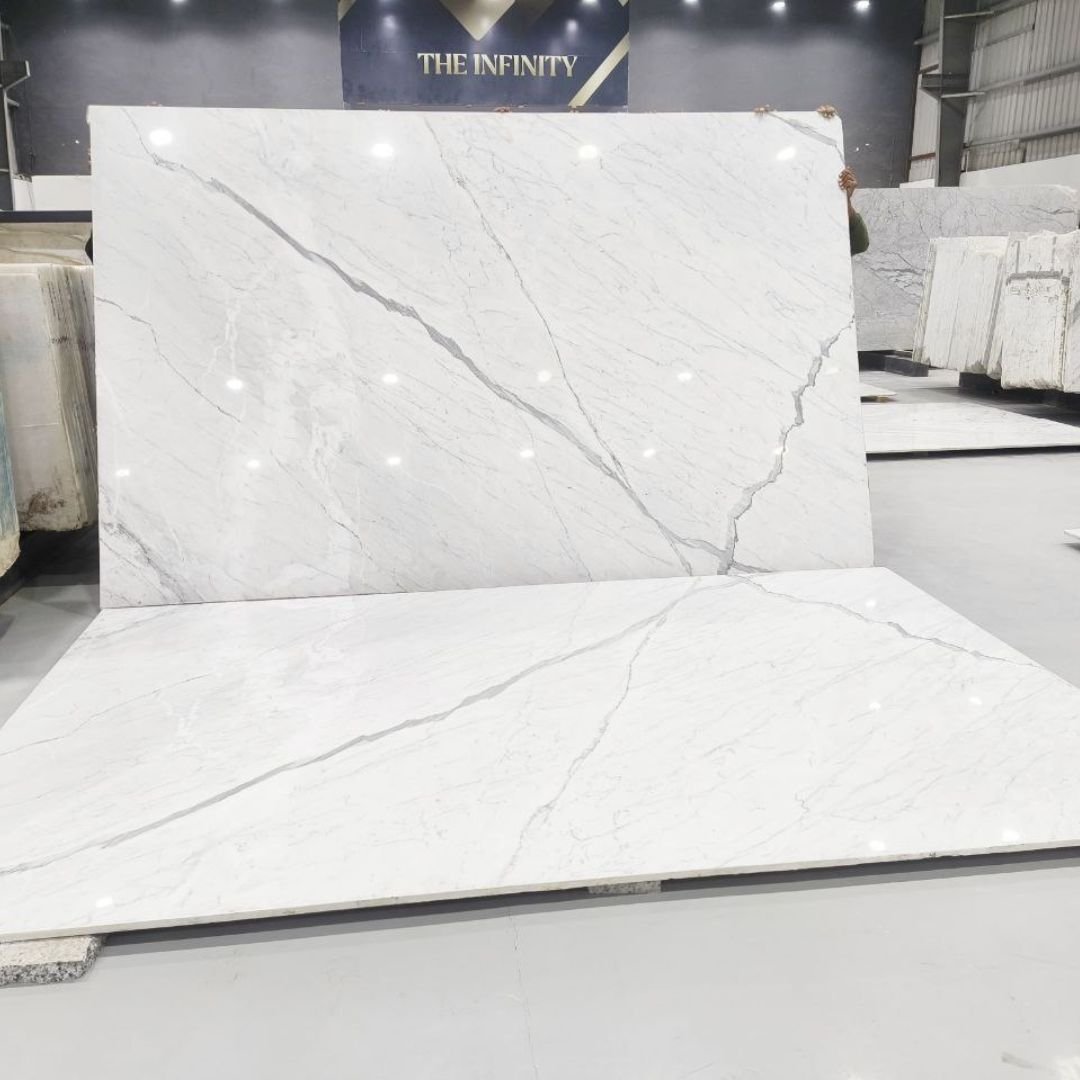
Bookmatching Makes Natural Differences Part of the Design
Bookmatching is an excellent example of how marble’s natural character can be deliberately used.
Two slabs are positioned opposite one another so that their veining creates a mirrored visual effect. Because marble contains naturally occurring patterns, the result can look like a large-scale artwork.
This technique works particularly well with strongly veined varieties where the movement of the stone becomes an architectural feature rather than simply a surface finish.
Why Photos Are Not Enough for Final Marble Selection
Online photographs can help you understand the general character of a marble, but they cannot always show the exact slab you will receive.
Screen brightness, photography, lighting conditions, camera settings, and image processing can all influence appearance.
For a significant project, it is better to evaluate the actual slabs and consider:
Background + vein pattern + thickness + finish + dimensions + application
This gives a more realistic understanding of how the stone will perform visually in the intended space.
Choosing Marble at The Infinity Marble
The Infinity Marble by Bhandari Marble Group offers marble buyers in Kishangarh access to a broad range of natural and imported marble options.
For customers specifically searching for Italian marble in Kishangarh, white marble in Kishangarh, Statuario Marble in Kishangarh, or imported marble in Kishangarh, slab-by-slab selection can help identify the material that best matches the project’s design requirements.
The goal should not simply be to find a slab that looks attractive in isolation. It should be to select marble whose natural pattern, colour, and movement work well with the architecture.
How to Choose Between Two Similar Marble Slabs
When two slabs appear similar, don’t immediately choose based on colour alone.
Look at them from a distance first. Then examine the veining more closely.
Consider:
- Overall background tone – Is it bright white, soft white, warm, or cool?
- Vein intensity – Do you want subtle movement or dramatic contrast?
- Pattern direction – Will the veins work with the layout of the room?
- Natural markings – Are they suitable for the intended application?
- Slab dimensions – Can the desired design be achieved with minimal joints?
- Lighting – How will the stone look under the project’s actual lighting?
- Matching potential – Can multiple slabs be coordinated successfully?
This approach makes the selection process much more practical.
The Beauty of Marble Is in Its Individuality
The slight difference between slabs is one of the defining qualities of natural marble.
A completely uniform surface may be easier to reproduce, but natural marble offers something different: every slab carries its own geological story.
Whether you choose Statuario, Carrara, Volakas, Michelangelo, Calacatta Gold, Thassos White, Dover White, Namibia White, or Pure White Marble, the individual slab can have its own balance of colour, movement, and veining.
That individuality is often what gives a luxury interior its character.
Final Thoughts
Natural marble looks different from one slab to another because it is formed by nature rather than manufactured to a fixed pattern. Mineral composition, geological conditions, quarry location, block selection, cutting direction, polishing, and lighting can all influence the final appearance.
For buyers searching for premium marble in Kishangarh, the best selection process is therefore not about finding a perfectly identical pattern. It is about understanding natural variation and choosing slabs whose individual characteristics complement the intended design.
At The Infinity Marble by Bhandari Marble Group, customers can explore natural and imported marble collections and select slabs according to colour, veining, application, and overall design requirements.
For enquiries and marble selection assistance:
Phone: +9116911191
Email: bhandarimarblegroup@gmail.com
Frequently Asked Questions
1. Can two slabs of Statuario Marble have completely different veining?
Yes. Statuario is a natural stone, so the intensity, direction, thickness, and distribution of veins can vary between slabs. This is why viewing the available slabs is important before making a final selection.
2. Does a whiter marble slab always mean better quality?
Not necessarily. Colour preference and stone quality are different considerations. A buyer should also examine the slab’s structure, finish, consistency, intended application, and overall suitability for the project.
3. Why does my marble look different at home than it did in the showroom?
Lighting is often a major reason. Daylight, warm LEDs, cool LEDs, reflections, and surrounding colours can all change how marble’s white background and veining are perceived.
4. Should I select marble by sample or by full slab?
For small applications, a sample can be useful for understanding the general appearance. For large or highly visible installations, viewing the full slab is much safer because natural movement may not be represented accurately by a small sample.
5. Can natural marble have small lines or marks without being damaged?
Yes. Some lines, mineral formations, colour changes, and surface characteristics are naturally present in marble. However, structural cracks or problematic defects should be assessed separately before purchase or installation.
6. Is it possible to predict exactly how every marble slab will look?
No. The general characteristics of a marble variety can be understood, but the exact pattern of a natural slab cannot be reproduced or predicted with complete certainty.
7. Which matters more for a luxury wall: marble colour or veining?
Both matter, but the priority depends on the design. A minimalist interior may benefit from a calmer background, while a feature wall may be designed around dramatic veining. The architectural setting should guide the choice.
8. Why should multiple slabs be selected together for one project?
Selecting slabs together helps maintain visual compatibility. When several slabs are required for one floor, wall, staircase, or large installation, comparing them at the same time makes it easier to coordinate their background tones and natural movement.
9. Can the same marble look warmer or cooler in different rooms?
Yes. Surrounding materials, wall colours, artificial lighting, daylight exposure, and reflections can influence the perceived temperature of marble. A white marble may appear cooler beside grey interiors and warmer alongside beige or wood finishes.
10. What should I check before approving a marble slab?
Check the full slab’s colour, vein movement, dimensions, thickness, finish, visible natural characteristics, and suitability for the planned application. For multi-slab projects, also check how the slabs relate to one another as a group.