

When an imported marble interior is planned well, the result is not simply a beautiful floor, wall, or countertop. The marble becomes part of the architecture itself. Its background colour, veining, slab size, finish, direction, and installation pattern can influence the entire character of a space.
This is why choosing marble should not begin and end with selecting a colour from a sample. A successful project requires coordination between slab selection, interior design, quantity planning, fabrication, installation, and final finishing.
For homeowners, architects, and interior designers looking for imported marble in Kishangarh, The Infinity Marble by Bhandari Marble Group offers access to premium natural stone collections suited to different interior concepts.
Whether the preference is the dramatic movement of Statuario Marble, the classic appearance of Carrara Marble, the distinctive character of Volakas Marble, or the luxury appeal of Michelangelo Marble and Calacatta Gold Marble, each stone needs to be selected according to the space where it will be installed.
Start With the Interior, Not Just the Marblewhite marble
One of the most common mistakes in marble planning is choosing a slab before deciding how the room should look.
Instead, first establish the architectural direction of the project.
Consider:
- The size and natural light of the room
- Wall and ceiling colours
- Furniture and upholstery
- Metal finishes such as brass, chrome, or black
- Door and window details
- Whether the marble will be used horizontally or vertically
- The desired visual intensity of the space
A heavily veined marble can become the main visual feature of a minimalist interior, while a quieter white marble may work better when furniture, artwork, or architectural details already provide strong visual elements.
This approach makes marble selection more purposeful.
Why Slab Selection Matters More Than Small Samples
A small marble sample cannot always communicate how a natural stone will appear across a large floor or feature wall.
Natural marble can change considerably from one part of a slab to another. Veins may become stronger, softer, wider, or more concentrated. Background tones can also show subtle variations.
For this reason, viewing full-size marble slabs is particularly valuable for premium interiors.
With Statuario Marble in Kishangarh, for example, the relationship between the white background and grey veining becomes much easier to understand when the complete slab is visible. The same principle applies to Carrara, Volakas, Michelangelo, Calacatta Gold, and other imported stones.
The objective is not simply to find the “whitest” slab. It is to find a slab whose natural movement works with the intended design.
Plan the Marble Layout Before Ordering
Once the marble has been shortlisted, the next step is layout planning.
Measure each area carefully and determine:
- Total floor area
- Wall-cladding requirements
- Staircase dimensions
- Vanity and countertop requirements
- Feature-wall measurements
- Skirting requirements
- Door or niche details
- Areas requiring bookmatching or vein matching
The layout should be prepared before final slab quantities are confirmed.
This is particularly important when the design depends on continuous veining. A visually impressive slab can lose much of its impact if the pieces are cut without considering how adjoining sections will meet.
Think About Vein Direction
Marble can look completely different depending on how it is positioned.
A long vein running along a hallway can make the space feel visually extended. The same marble rotated across the width can create a completely different impression.
For feature walls, bedrooms, living rooms, and entrance spaces, architects often consider the direction of natural movement before cutting begins.
With expressive stones such as Statuario Marble, Michelangelo Marble, and Calacatta Gold Marble, vein direction becomes an important part of the design rather than a minor installation detail.
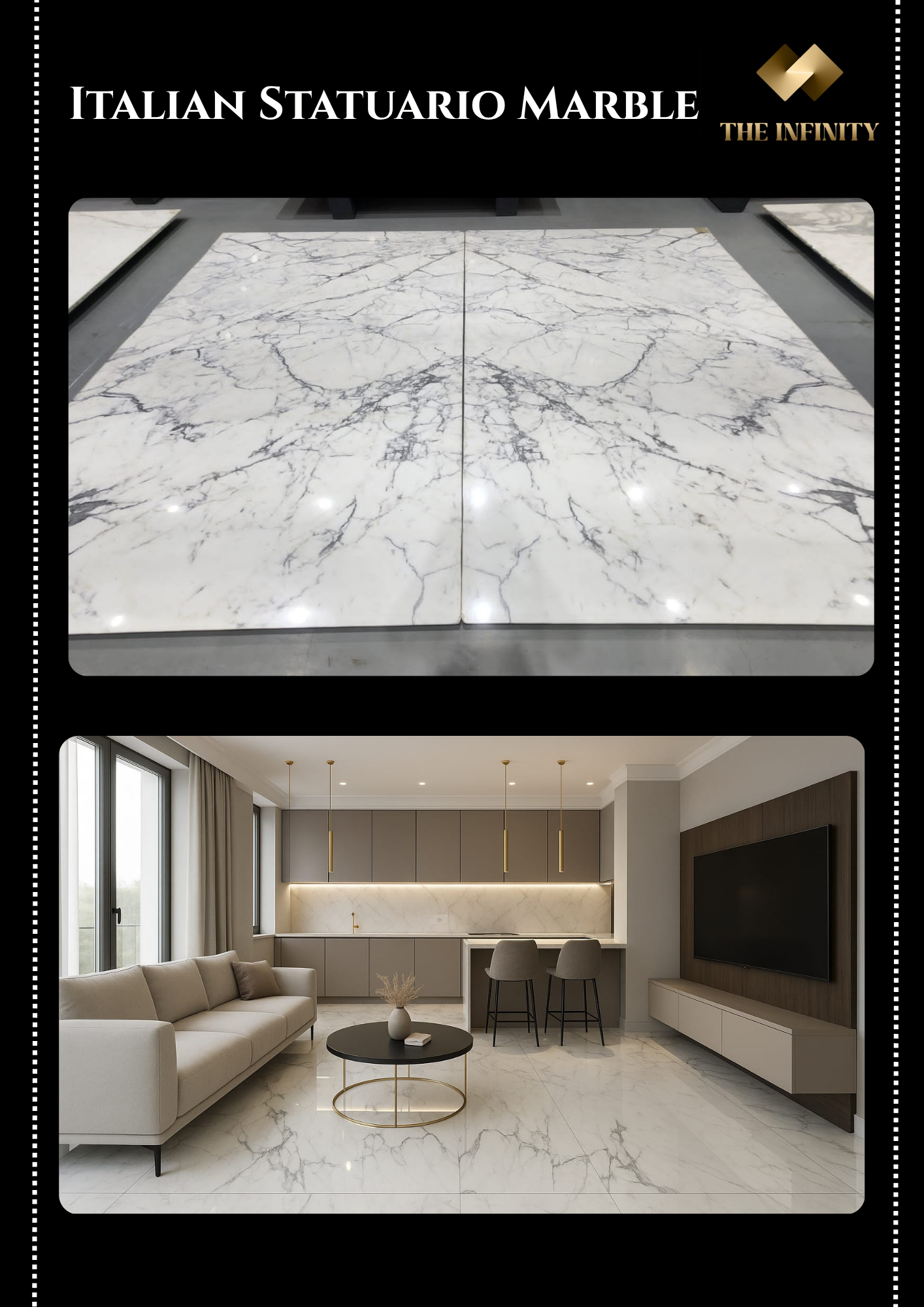
Bookmatching Can Change an Entire Feature Wall
Some imported marble slabs are particularly suitable for bookmatching, where adjoining slabs are arranged to create a mirrored visual effect.
This technique can be highly effective for:
- Statement walls
- Luxury living-room backdrops
- Reception areas
- Fireplace surrounds
- Hotel lobbies
- Large entrance features
However, bookmatching should be planned from the beginning. The slabs need to be selected and positioned according to their natural patterns before fabrication.
Trying to create a bookmatched effect after random cutting can limit the final result.
Choosing the Right Marble for Different Areas
There is no single imported marble that is ideal for every interior application.
Statuario Marble is often selected when the design requires a sophisticated white background combined with noticeable grey veining. It can create a strong statement in living rooms, entrances, feature walls, floors, and luxury bathrooms.
Carrara Marble is known for its classic white-to-light-grey appearance and refined veining. It can suit interiors where the designer wants a timeless natural-stone character rather than extremely dramatic movement.
Volakas Marble offers a distinctive white appearance with natural grey patterns. It can be considered for elegant residential interiors, wall applications, floors, and decorative areas.
Michelangelo Marble can bring a more expressive luxury appearance to interiors where natural pattern and visual character are important.
For interiors that combine white marble with warmer accents, Calacatta Gold Marble can introduce golden or warm-toned veining that works particularly well with brass, beige, cream, and contemporary luxury finishes.
Thassos White Marble is associated with a bright white appearance and can be useful when the design direction calls for a clean, luminous aesthetic.
Dover White Marble can work well for elegant interiors requiring a softer white marble character.
Namibia White Marble is another option for designers seeking a premium white marble appearance with a distinctive natural-stone identity.
For minimal interiors where the emphasis is on a cleaner white surface, Pure White Marble can be considered according to the project’s application and desired finish.
The right choice ultimately depends on the complete interior rather than the marble name alone.
Calculate Quantity With the Final Layout in Mind
Marble requirements should not be calculated purely from the carpet area.
Additional material may be needed because of:
- Cutting patterns
- Vein matching
- Bookmatching
- Edge requirements
- Natural variation
- Installation wastage
- Replacement or future maintenance requirements
For premium marble projects, a layout drawing can help determine how slabs will be divided before fabrication.
This can reduce unnecessary cutting and, more importantly, help preserve attractive natural patterns.
Coordinate Fabrication Before Installation
After slab selection and layout approval, fabrication becomes the next critical stage.
The fabricator needs clear information regarding:
- Final dimensions
- Cut-outs
- Edge profiles
- Joint locations
- Sink openings
- Electrical or plumbing requirements
- Staircase shapes
- Wall niches
- Pattern direction
A small change at the fabrication stage can affect the visual continuity of a marble installation.
For high-value imported marble, communication between the designer, supplier, fabricator, and installer is therefore extremely important.
Installation Is Part of the Design
Even an exceptional slab can look disappointing when installation is poorly planned.
The installer should understand the approved slab layout before fixing begins. Slabs should be checked for their intended position rather than simply installed according to convenience.
Particular attention should be given to:
- Joint alignment
- Level differences
- Pattern continuity
- Surface preparation
- Adhesive or fixing system
- Edge finishing
- Grouting
- Final polishing
The installation team should also know which sections are intended to be visually prominent.
A feature wall, for instance, deserves more planning than an area where furniture will cover most of the stone.
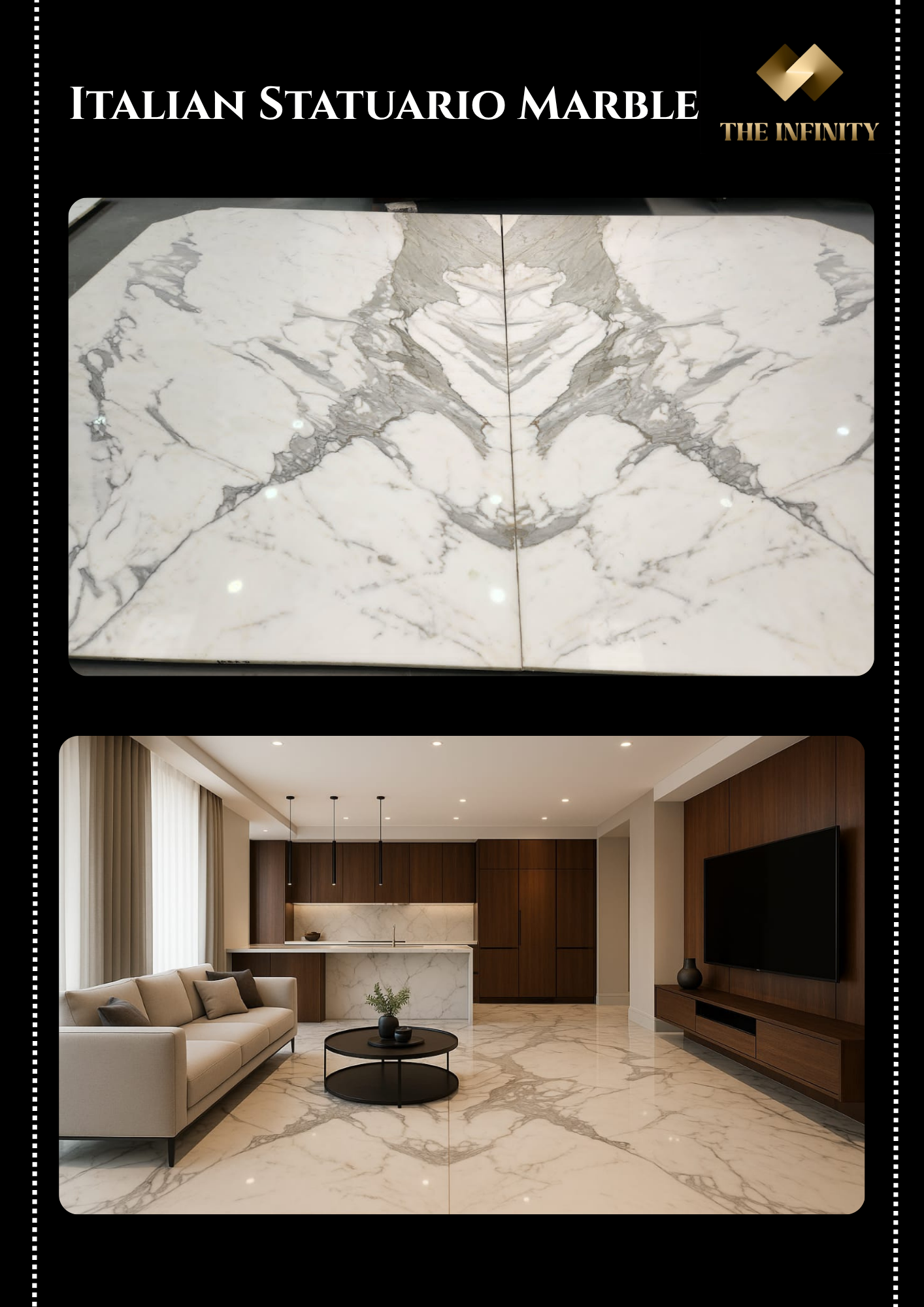
Consider Lighting Before Finalising the Marble
Lighting can dramatically influence how marble appears.
Natural daylight can reveal subtle movement that may not be visible under artificial lighting. Warm lighting can make cream and golden tones more prominent, while cooler lighting can emphasise grey and white characteristics.
For this reason, marble should ideally be considered alongside the proposed lighting design.
This is especially useful for white marble in Kishangarh projects where the final appearance depends heavily on the relationship between the stone, surrounding materials, and illumination.
Where Imported Marble Works Best
Imported marble can be incorporated throughout a home when the material is selected according to the function of each area.
Popular applications include:
Entrance: A carefully selected marble floor can create the first visual impression of the home.
Living room: Large-format flooring or a dramatic feature wall can become the centre of the design.
Staircase: Marble can create continuity between different levels of an interior.
Bedroom: Softer marble patterns can provide an elegant background without overwhelming the room.
Bathroom: White and light-toned marble can create a spacious, refined atmosphere.
Kitchen: Where marble is suitable for the intended application, careful selection and professional installation become particularly important.
Feature walls: Strong natural veining can be displayed almost like artwork.
Why Kishangarh Is Important for Imported Marble Buyers
For buyers searching for Italian marble in Kishangarh, imported marble in Kishangarh, or Statuario Marble in Kishangarh, access to a wide collection can make the selection process more practical.
Kishangarh has developed into a major destination for marble and natural stone, giving architects, designers, builders, and homeowners an opportunity to compare different materials and visual characteristics in one market.
The Infinity Marble by Bhandari Marble Group focuses on premium marble collections for projects where material selection, presentation, and architectural application are important.
A Better Way to Plan Your Marble Project
Instead of treating marble procurement as a single purchase, think of it as a sequence:
Interior concept → Area measurement → Marble shortlist → Full-slab inspection → Layout planning → Quantity calculation → Slab allocation → Fabrication → Installation → Finishing
Each stage affects the next.
A beautiful slab selected without considering the layout can create unnecessary wastage. A good layout without accurate fabrication can disrupt the pattern. And excellent fabrication can still be compromised by poor installation.
Planning all stages together creates a much more controlled result.
Final Thoughts
Planning an imported marble interior is about much more than choosing a premium stone. The real quality of the project comes from matching the right slab with the right space, layout, lighting, fabrication method, and installation approach.
For projects using Statuario Marble, Carrara Marble, Volakas Marble, Michelangelo Marble, Calacatta Gold Marble, Thassos White Marble, Dover White Marble, Namibia White Marble, or Pure White Marble, seeing the natural slab and planning its placement before cutting can make a significant difference.
For architects, interior designers, and homeowners searching for Statuario Marble in Kishangarh, imported marble in Kishangarh, Italian marble in Kishangarh, or premium white marble in Kishangarh, The Infinity Marble by Bhandari Marble Group provides a destination for exploring premium marble collections and planning sophisticated natural-stone interiors.
Frequently Asked Questions
1. Should marble be selected before finalising the interior design?
Ideally, the marble and interior design should be developed together. Furniture, lighting, wall finishes, and marble should complement one another rather than being selected independently.
2. How can I know whether a marble slab will suit my room?
Look at the complete slab and compare its background, vein density, movement, and colour with your flooring, furniture, lighting, and other finishes. Full-slab viewing gives a much better idea than a small sample.
3. Is every imported marble suitable for bookmatching?
No. Bookmatching depends on the natural pattern and the way compatible slabs are selected. The slabs should be assessed specifically for this purpose before cutting.
4. Why does the same marble sometimes look different in two interiors?
Lighting, slab selection, polishing, surrounding colours, installation direction, and natural variation can all influence the appearance of marble.
5. What should I check before approving marble cutting?
Confirm the approved layout, slab numbers, vein direction, visible faces, dimensions, joints, cut-outs, and bookmatching requirements before fabrication starts.
6. Can different marble varieties be used in one house?
Yes. Different marbles can be used to create distinct moods in different areas, provided their colours, patterns, finishes, and overall design language work together.
7. Is Statuario Marble a good choice for a statement interior?
Statuario Marble can be an excellent choice when the project calls for a white marble background with prominent natural veining. Its suitability depends on the specific slab and the intended application.
8. Why is slab allocation important?
Slab allocation determines where each portion of the natural stone will be used. Proper allocation can help preserve attractive veins and reduce visual inconsistencies between adjoining pieces.
9. Should lighting be finalised before marble installation?
The lighting design should at least be considered before final installation because illumination can significantly affect how white, grey, cream, and golden marble tones are perceived.
10. What is more important: marble quality or installation quality?
Both matter. A premium marble slab needs skilled fabrication and installation to display its natural characteristics properly. Material quality alone cannot compensate for poor workmanship.